
Industrial electricity price 2026
What you need to know now
Check now how your company can reduce electricity costs by up to 60%.

Over 200 companies trust us












Brief explanation
What is the industrial electricity price?
The industrial electricity price is a temporary state relief measure. The aid framework is based on the EU's Clean Industrial Deal State Aid Framework (CISAF), which allows discounts of up to 50% of the wholesale price on up to 50% of consumption, with a minimum price of 50 EUR/MWh (5 ct/kWh). The goal is to secure competitiveness, preserve locations and jobs, and accelerate decarbonization through a reinvestment obligation.
From 01/01/2026 for 3 years
Runtime
approx. €150,000 per 10 GWh
Funding per 10 GWh of electricity consumption*
91 economic sectors
Companies from 91 economic sectors are eligible**
No minimum size
No minimum consumption planned so far
50%
The subsidy must be invested in efficiency and flexibility measures
10% promotional bonus
When using reinvestment in battery storage solutions or similar.
*Calculation is based on the reference price (wholesale average) for 2025; final values for 2026 may vary (as of 13.02.2026).
**No minimum size. As of 13.02.26 based on the announcements of the Federal Government so far
Eligibility
Which companies are eligible?
Only companies from the sectors of the so-called KUEBLL list (EU Carbon Leakage List) are eligible. This list covers energy-intensive industries that are subject to an increased risk of carbon leakage.
These include 91 (sub-)sectors, including chemicals, metal, glass/ceramics, cement, paper/plastics, battery cells, semiconductors as well as areas of mechanical engineering and raw material extraction.
A company is included in the list if it can prove its affiliation by means of a valid WZ code. This code is transmitted by the state statistical offices to the Federal Office for Economic Affairs and Export Control (BAFA).
Eligibility calculator
Check in just a few steps whether your company is eligible for the discounted industrial electricity price.
Terms and Conditions
What are the conditions for the industrial electricity price?
Companies must invest at least 50% of the aid received in decarbonisation measures within 48 months. These include energy storage, demand flexibility, electrification, electrolysers, self-generation from renewable energies, efficiency measures, infrastructure upgrades, new or modernised RE plants, as well as new PPAs.
The aid amount will be increased by 10% if the company proves that at least 80% of the counter-performance obligation is invested in measures to increase demand flexibility. At least 75% of this flexibility bonus must in turn be reinvested in counter-performances.
The implementation of the planned counter-performance measures may only begin after the application has been submitted. However, companies can have it checked in advance whether a planned measure is eligible for recognition in principle. Furthermore, it is permitted to spread investment sums over several years, as long as the specified implementation deadline is met.
Price reduction
Electricity price for a portion of consumption will be reduced to about 5 cents/kWh (€50/MWh)
Scope of funding
Up to 50% discount on the wholesale price, for a maximum of 50% of electricity consumption
Flexibility bonus
An additional bonus is being reviewed for companies that make their electricity demand more flexible
Runtime per company
Maximum 3 years (2026 - 2028), retroactive payout
Schedule
When does the industrial electricity price come into effect?
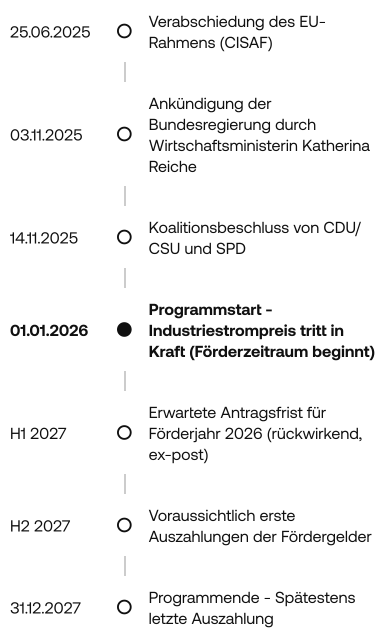
The EU Commission verbally approved the industrial electricity price on January 14, 2026: Chancellor Merz explained that, in addition to the industrial electricity price, the electricity price compensation (SPK) and the power plant strategy were also largely approved. However, the final funding guideline is still being coordinated within the federal government, which is why its entry into force is still pending. The Federal Ministry for Economic Affairs currently assumes that both the unresolved financing and detailed questions as well as the final approval by the EU Commission will be clarified by the end of Q2 2026.

How it works
How do the application
and reimbursement processes work?
Applications for the industrial electricity price will be submitted exclusively online via the application forms of the Federal Office for Economic Affairs and Export Control (BAFA). The exact deadline for submitting applications has not yet been determined. What is clear, however, is that the deadline will end no earlier than March 31 and no later than September 30, 2027.
Companies that demonstrate an eligible electricity consumption of at least 10 GWh as part of their application are required to submit an audit certificate. This can be issued by an auditor, an auditing firm, or a cooperative auditing association.
The aid will be paid out in the year following the accounting year. When submitting the application, a self-declaration by the company must be provided, stating that investments will be made to the required extent. After implementation, or at the latest 48 months after the grant was awarded, a list of the measures carried out, including the volume of investment, must be submitted to the enforcement authority.

How it works
How does the financing work?
The funding for the industrial electricity price is currently not yet fully secured. According to an internal paper from the Federal Ministry for Economic Affairs, the subsidy is indeed to be financed from the Climate and Transformation Fund (KTF), a special fund for energy and climate projects, but no corresponding funds are provided for in the current financial planning for the years 2027 to 2029. A final agreement with the Federal Ministry of Finance is therefore still pending. According to the Ministry of Economic Affairs, total costs of around three billion euros are estimated for the three-year term.
The aid is paid out in the year following the accounting year (e.g., relief for 2026 is paid out in 2027). When submitting the application, a self-declaration by the company is required stating that investments are being made in the required volume. After implementation or at the latest 48 months after granting, a list of the measures carried out, including the investment volume, must be submitted to the enforcement authority.