Updates
Industrial electricity price 2026 decoded: What you need to know now

Written by:
Linda Elberskirch
Industrial electricity price in a nutshell
From 2026-2028, energy-intensive companies from 91 (sub)industrial sectors on an official list (KUEBLL list) are to be relieved; disbursements will take place in the respective following year.
The aid relates exclusively to energy procurement; grid fees, levies, charges, and taxes are applied additionally.
The relief is based on the reference wholesale price as a market average - recipients receive up to a 50% discount applied to a maximum of 50% of their annual electricity consumption.
The lower limit of the subsidy is 5 ct/kWh
At least 50% of the aid received must be reinvested in decarbonization measures within 48 months
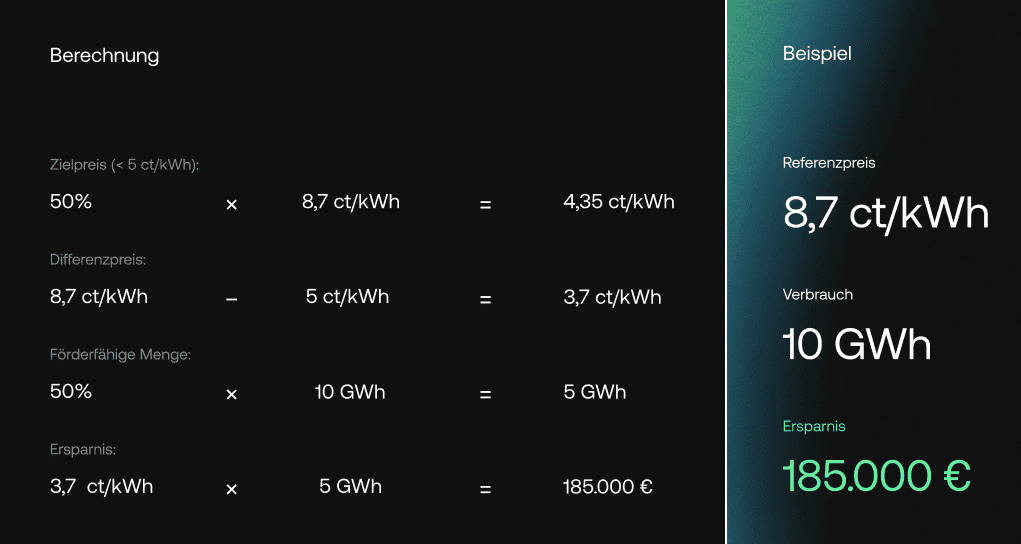
These were many relative figures. Quite concretely: For an industrial company with a consumption of 10 GWh and a reference price of 8.7 ct/kWh, it means a relief of almost €185,000.
In a joint webinar with lawyer and partner Yvonne Hanke from RITTER GENT COLLEGEN, trawa held a webinar on the industrial electricity price.
If you would like to gain more clarity on the current clarifications regarding the industrial electricity price and understand which opportunities you should seize for your business now, download our free webinar with Robert Quick (Co-Founder & Managing Director of trawa) and Yvonne Hanke (Lawyer and Partner at RITTER GENT COLLEGEN) on the topic.
Click here for the Webinar: Industrial Electricity Price – These clarifications and surprises you should know.
What is the industrial electricity price?
The industrial electricity price is a temporary state relief. The aid framework is based on the EU's Clean Industrial Deal State Aid Framework (CISAF), which allows discounts of up to 50% of the wholesale price on up to 50% of consumption, with a minimum price of 50 EUR/MWh (5 ct/kWh). The goal is to secure competitiveness, preserve locations and jobs, as well as accelerate decarbonization through a reinvestment obligation.
Reduction of the average annual wholesale price (reference price) by max. 50%
Reduction for max. 50% of the annual electricity consumption (with optimal degressive funding option)
Target price for the eligible consumption 5 ct/kWh (lower limit)
Quid pro quo: Reinvestment of at least 50% of the aid amount received in climate protection & energy efficiency measures: renewable generation capacities, energy storage, demand flexibility, energy efficiency, electrolyzers, electrification
Which companies are eligible?
Only companies from the sectors on the so-called KUEBLL list (EU Carbon Leakage List) are eligible. This list includes energy-intensive industries that are subject to an increased risk of shifting production abroad.
This includes 91 (sub-)sectors, including chemicals, metal, glass/ceramics, cement, paper/plastics, battery cells, semiconductors, as well as areas of mechanical engineering and resource extraction.
A company is added to the list if it can prove its affiliation using a valid WZ code. This code is transmitted by the state statistical offices to the Federal Office for Economic Affairs and Export Control (BAFA).
How does the industrial electricity price work?
The industrial electricity price is based on a reference value from the wholesale market, which is announced by BAFA. The basis is the annual average of the base future contracts of the previous year with delivery in the billing year. For 2026, the average of the base futures from 2025 counts.
The aid amounts to 50% of the reference price, but with a lower limit of 5 ct / kWh. For example, if the reference price is 8.7 ct / kWh, 50% of this would mathematically be 4.35 ct / kWh. Due to the lower limit, however, the aid is set at 3.7 ct / kWh. Please note, however, that this is only one of various conceivable calculation methods. The final calculation logic is still unclear.
The subsidy only applies to 50% of the annual electricity consumption. The amount of electricity that the company actually consumed itself in the respective billing year is eligible (a clear separation from third-party quantities is required). The indirect electricity consumption for the grid-bound, outsourced production of secondary energies and media can also be taken into account. This includes, among other things, industrial gases including compressed air, cooling, heating, steam, or water within industrial parks.
Note: Only one of the conceivable calculation methods is shown. The final calculation logic is still unclear.
What does the industrial electricity price mean for companies with electricity price compensation (SPK)?
Companies that already receive electricity price compensation (SPK) or want to apply for it must not receive double funding through the industrial electricity price and the SPK. Nevertheless, a combination of both programs is possible. For example, individual plants can be funded via the electricity price compensation, while the remaining electricity consumption benefits from the industrial electricity price.
This combination can be particularly interesting for companies that can only have certain plants funded via the SPK. This is because, calculated per megawatt-hour, the electricity price compensation is often higher than the relief via the industrial electricity price.
It is important to note: The total subsidy amount must not exceed the higher of the two permitted maximum aid amounts.
What are the conditions for an industrial electricity price?
Companies must invest at least 50% of the aid received within 48 months of the aid being approved into decarbonization measures. These include energy storage, demand flexibility, electrification, electrolyzers, self-generation from renewable energies, efficiency measures, infrastructure modernization, new or modernized renewable energy plants, as well as new PPAs.
The aid amount is increased by 10% if the company proves that at least 80% of the quid pro quo obligation is invested in measures to increase demand flexibility. Of this flexibility bonus, at least 75% must in turn be reinvested in quid pro quo measures.
The implementation of the planned quid pro quo measures may begin after the start of the billing year. This means: Anyone applying for the industrial electricity price for 2026 can initiate the necessary measures directly in parallel with submitting the application.
Companies can have it checked in advance whether a planned measure is eligible for recognition in principle. In addition, it is permitted to spread investment amounts over several years, as long as the specified implementation deadline is met.
The specific conditions are still being discussed in detail with the European Commission as part of the notification process.
How does the application process for the industrial electricity price work?
The application for the industrial electricity price will be made exclusively online via the application forms of the Federal Office for Economic Affairs and Export Control (BAFA). Exactly when the applications must be submitted is not yet fixed. However, it is clear that the deadline will end no earlier than March 31 and no later than September 30, 2027.
Companies that demonstrate an eligible electricity consumption of at least 10 GWh as part of their application are required to present an audit certificate. This can be issued by an auditor, an auditing company, or a cooperative auditing association.
It is important to note: The application process does not operate on a "first come, first served" basis. The time of submission therefore has no influence on the amount of aid granted. Since the funding is subject to the availability of budget funds, however, reductions may occur. If funds are insufficient, all essentially eligible aid will be reduced proportionally. (The total sum of available budget funds is divided by the sum of all approved aid.)
How does the reimbursement work?
The aid will be paid out in the year after the billing year (e.g., relief for 2026 will be paid in 2027). When applying, a self-declaration by the company must be submitted, stating that investments will be made to the required extent. After implementation or at the latest 48 months after grant, a list of the measures carried out, including the investment volume, must be submitted to the enforcement authority.
How is the industrial electricity price financed?
The financing of the industrial electricity price is not yet fully secured. According to an internal paper from the Federal Ministry for Economic Affairs, the funding is to be financed from the Climate and Transformation Fund (KTF), a special fund for energy and climate projects, but no corresponding funds are provided for in the current financial planning for the years 2027 to 2029. A final agreement with the Federal Ministry of Finance is therefore still pending. According to the Ministry of Economics, total costs of around three billion euros are estimated for the three-year term.
When will the industrial electricity price take effect?
The EU Commission approved the industrial electricity price in April 2026. Energy-intensive German companies can therefore apply for the relief retroactively starting in 2027. However, the final funding guideline has not yet been published.
Conclusion
The industrial electricity price is coming – but it is temporary, carries strict conditions, and is not for all companies. Furthermore, in practice, the regulation will turn out significantly different from the promised price of 5 ct/kWh. The reason: the aid only applies to 50% of electricity consumption – and of this portion, half must obligatorily be reinvested.
For eligible sectors, this nevertheless means short-term relief and a clear investment signal. trawa accompanies you end-to-end: from identifying and prioritizing the appropriate energy efficiency measures, through commercial evaluation, to implementation – including advice on battery storage, intelligent control, and data-driven load flexibility to maximize the funding effects.
For everyone else, the rule is: take action yourself. Optimize cost structures, make load profiles flexible, and professionalize procurement to manage volatility and seize market opportunities. trawa is your partner here too – pragmatic, measurable, and without extra effort like additional staff.
Contact us – we are happy to support you.
Sources:
https://www.zeit.de/politik/deutschland/2025-11/industriestrompreis-koalitionsausschuss-bundesregierung-ticketsteuer
https://www.produktion.de/wirtschaft/industriestrompreis-warum-er-zur-schicksalsfrage-wird/2120798
https://www.br.de/nachrichten/deutschland-welt/wirtschaft-staerken-koalition-beschliesst-industriestrompreis,V2SV3iL
https://www.tagesschau.de/wirtschaft/unternehmen/reiche-industriestrompreis-2026-100.html
https://www.handelsblatt.com/politik/deutschland/energiepolitik-industriestrompreis-enttaeuscht-erwartung-vieler-unternehmen/100176155.html
https://www.sparkasse.de/aktuelles/industriestrompreis.html#hohe-energiekosten-belasten-europas-indu
Updates