Updates
Energy price relief 2026: What is really behind the federal government's billion-dollar relief package

Written by:
Linda Elberskirch
The Relief Measures in Brief
As of January 1, 2026, three relief measures are due to come into effect – subject to the final approval of the Federal Council (Bundesrat) regarding the electricity tax and the EU notification process for the industrial electricity price.
Electricity Tax Relief
The federal government provides around 3 billion euros annually from the federal budget to make the electricity tax reduction from 2.05 ct/kWh to the EU minimum rate of 0.05 ct/kWh permanent for manufacturing companies as well as agriculture and forestry.
Beneficiaries: Manufacturing sector as well as agriculture and forestry
Regulatory status: Federal Council approval is missing (as of Dec. 2025)
Relief at 10 GWh consumption: €200,000 for an eligible company
Grid Fee Relief
The federal government finances 6.5 billion euros of transmission grid costs annually from the Climate and Transformation Fund (KTF) to lower grid fees and thus electricity costs for all electricity consumers.
Beneficiaries: All electricity consumers
Regulatory status: Approved
Relief at 10 GWh consumption: approx. €104,000 (varies significantly depending on consumption patterns and grid operator; including the effect of higher surcharges)
Industrial Electricity Price
To further relieve energy-intensive companies, an industrial electricity price is being introduced, financed from the Climate and Transformation Fund (KTF) with a total volume of around 3 billion euros. It is aimed at companies from 91 (sub-)industrial sectors on the official KUEBLL list. Since the industrial electricity price is currently being specified further, a detailed presentation is provided in a separate article.
Regulatory status: EU notification process pending
Relief at 10 GWh consumption: €150,000 (varies depending on reference price)
Beneficiaries: Companies from the KUEBBL list
Read more in our separate blog article
What is the electricity tax?
The electricity tax is levied on every kilowatt-hour consumed and has been in place since 1999. Originally, it was intended to create a financial incentive to use electricity more efficiently and reduce consumption.
Currently, the tax rate in Germany is 2.05 ct/kWh – a value that has remained unchanged since 2003. For comparison: the EU only prescribes 0.05 ct/kWh for commercial and 0.10 ct/kWh for non-commercial consumers as minimum tax rates.
What does the electricity tax relief mean?
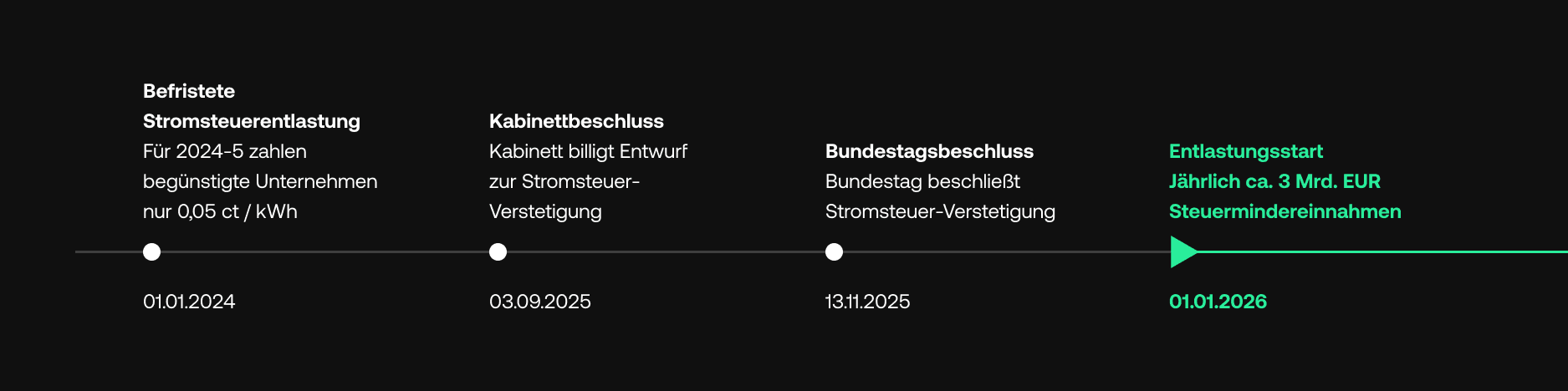
As early as 2024, the federal government launched significant relief for energy-intensive industries with the "Electricity Price Package". Since then, companies in the manufacturing sector as well as agricultural and forestry businesses have been able to reduce their electricity tax to the EU minimum rate of 0.05 ct/kWh. In practice, this means: the electricity tax previously paid is almost fully refunded.
Originally, this regulation was limited to the period from January 1, 2024, to December 31, 2025. With the current draft law to amend the Energy and Electricity Tax Act, the relief is now set to continue permanently. This means that the tax rate for the companies concerned will be fixed at the European minimum rate of 0.05 ct/kWh starting from 2026.
For a company with an annual consumption of 10 GWh, this means a relief of approx. 200,000 euros.
Who is eligible?
Around 600,000 companies in Germany are entitled to the electricity tax reduction – from the manufacturing sector as well as agriculture and forestry.
The manufacturing sector includes, for example, industries such as mining, the automotive industry, mechanical engineering, chemicals, energy and water supply, and the construction industry. In agriculture and forestry, businesses such as arable farming, forestry, or pond fish farming benefit from the regulation. These sectors are located in sections A and C to F and class 05.02 of the Classification of Economic Activities by the Federal Statistical Office.
Companies can apply for the tax reduction if their annual electricity consumption is at least 12,500 kWh.
How does the refund process work?
The relief is not granted automatically, but only upon application and takes the form of a retrospective refund. The respective main customs office is responsible for processing the application.
The application can be submitted for the respective consumption year and must be filed by December 31 of the following year at the latest.

How is the relief funded?
The electricity tax relief is financed entirely from the federal budget and costs it around three billion euros annually.
When does the electricity tax relief take effect?
The stabilization of the electricity tax reduction is scheduled to come into effect on January 1, 2026. The Bundestag approved the amendments to the Electricity Tax Act on November 13. The Federal Council still has to hold final consultations on it.
What are grid fees?
Grid fees are the charges levied by electricity grid operators to finance the operation, maintenance, and expansion of the grid infrastructure. They are paid by all electricity consumers connected to the public grid – from private households to industrial enterprises.
How high are grid fees?
According to the German Association of Energy and Water Industries (BDEW), grid fees currently make up around 28% of the total electricity price. The exact level of grid fees varies depending on region/grid operator, consumption volume, and grid level. Basically, the fees consist of two components:
Commodity charge: for the total amount of electricity consumed.
Demand charge: for the highest load peak in the billing year.
The following factors in particular influence the commodity charge (AP) and demand charge (LP):
Load profile: With consistently high consumption, the share of the demand charge is higher; with irregular consumption with high load peaks, the commodity charge predominates.
Utilization hours (annual energy [kWh] divided by maximum load [kW]): At less than 2,500 h/year, billing is more strongly performance-based (higher LP, lower AP); above 2,500 h, it is the other way around. In addition, there are already relief mechanisms for atypical grid usage:
Due to load peaks during low-consumption times:
If it can be foreseen that the load peaks lie outside the high-load time window defined by the distribution grid operator (time window in which the electricity grid is particularly busy - frequently mornings & evenings on business days), companies are entitled to reduced grid fees (approx. 20-50% reduction).Due to particularly consistent consumption ("baseload privilege" or "7,000h rule"):
If companies reach at least 2,500 utilization hours per year and more than 10 GWh annual consumption, they are also entitled to reduced grid fees. From 7,000 utilization hours, the grid fee is limited to 20% of the regular rate; between 3,500 and 7,000 hours, a linear reduction occurs.
Location: Each distribution grid operator has its own fee structures.
Grid level: In higher voltage levels, the provision of capacity is greater (lower AP, higher LP).
What does the grid fee relief mean?
Starting from 2026, the federal government will support German transmission grid operators with a total of 6.5 billion euros to noticeably lower grid fees – and thus electricity costs – for households and businesses.
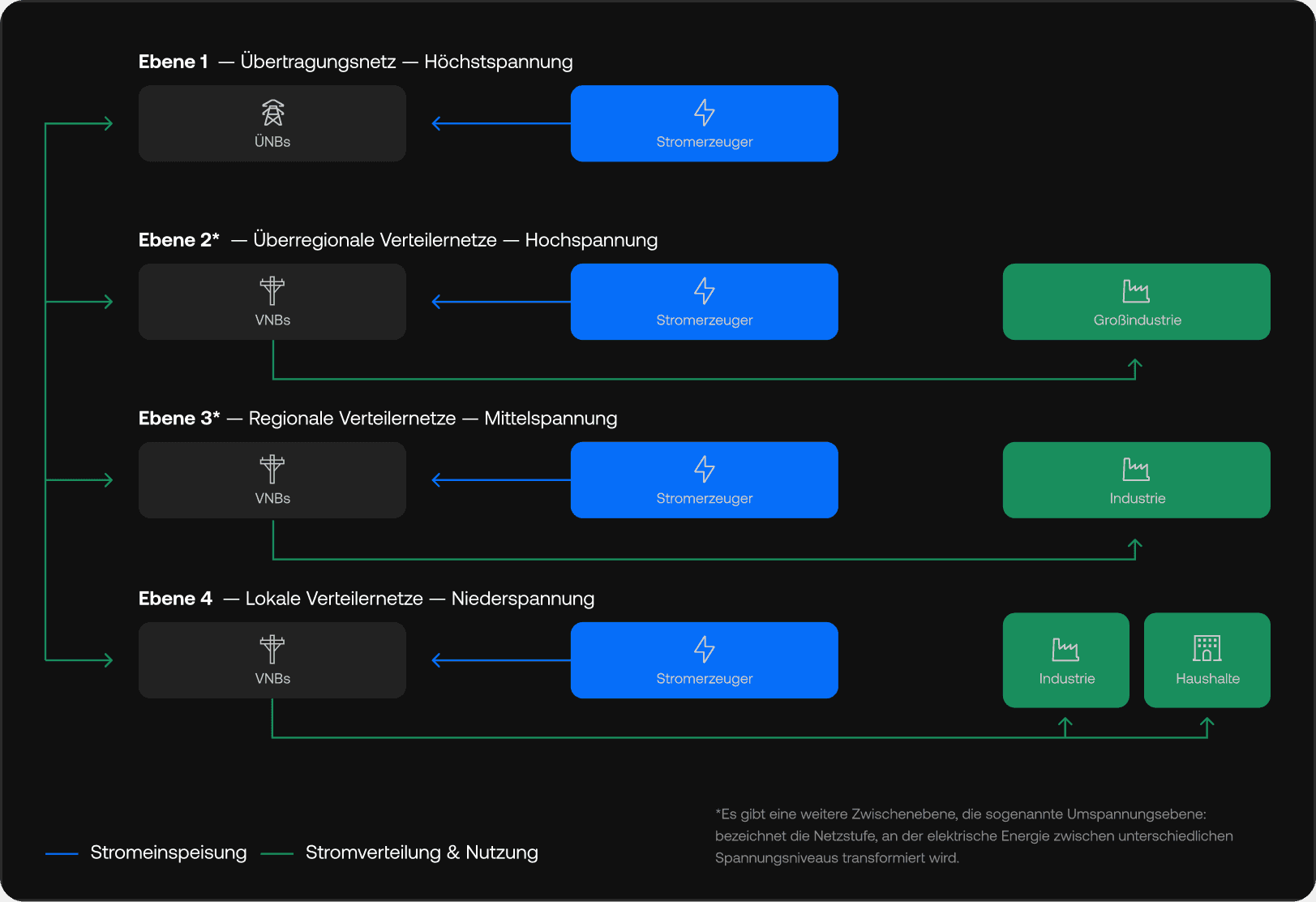
The federal government's subsidy initially goes to the four transmission grid operators, who are legally obliged to use the funds entirely to reduce grid fees. The relief is then gradually passed on to end consumers through the downstream distribution grid levels. Details on transmission and distribution grid operators can be found in the excursus on the next page.
However, the relief does not reach end consumers in a 1:1 ratio because it is passed down. For companies connected to higher voltage levels, such as large industrial firms, the price reduction has the strongest impact.
The actual amount of relief depends on the grid costs of the respective distribution grid operator. These, in turn, vary depending on the degree of expansion, modernization, and regional grid structure. Grid operators that expand or modernize their grids more heavily have correspondingly higher costs and are allowed to levy higher fees. Therefore, the relief varies from region to region.
An example calculation for a medium-sized company in North Rhine-Westphalia shows that this can result in savings of around €104,000 (including the effect of higher surcharges) — see the example calculation later in this document.
What are Transmission System Operators (TSOs)?
Transmission system operators are responsible for transporting large quantities of electricity over long distances. Their main task is to ensure the balance between electricity generation and consumption in real time and to maintain the stability of the overall grid. There are four transmission system operators in Germany: Amprion, 50Hertz Transmission, TenneT TSO, and Transnet BW.
What are Distribution System Operators (DSOs)?
Distribution system operators are responsible for grid connection and supplying end customers. They handle the transport of electricity from the transmission grid to industry, businesses, and households. In Germany, there are over 800 DSOs, mostly regional or municipal grid operators.
For medium-sized enterprises, the medium- or low-voltage grid is of particular relevance – this is also where the grid fees are incurred, which are to be reduced from 2026 through the relief measures.
German Grid Structure: Medium-sized businesses are usually connected to medium or low voltage
Who is eligible?
The relief benefits all electricity consumers – including private households, enterprises, and medium-sized businesses.
How is the relief funded?
From 2026, the federal government will assume 6.5 billion euros annually of the costs for the transmission grids. This measure is financed from the Climate and Transformation Fund (KTF) – a special federal fund financed predominantly by revenues from European emissions trading.
When does the grid fee relief take effect?
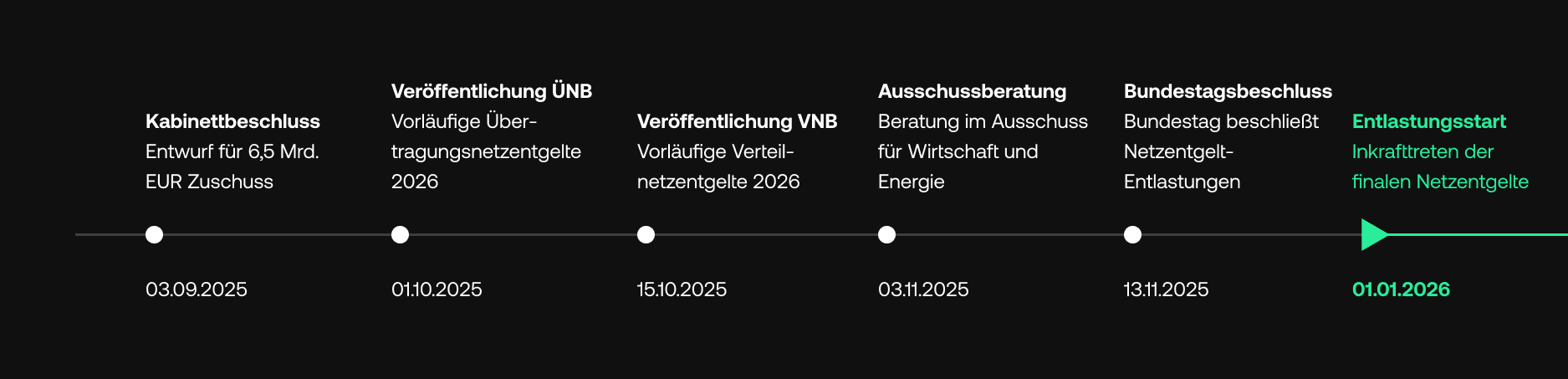
The grid fee relief is scheduled to come into effect on January 1, 2026.
On October 1, the transmission system operators already published their provisional grid fees; the distribution system operators followed on October 15. The respective preliminary price sheets can be viewed on the DSOs' websites.
The Federal Council finally approved the changes on November 21. After being signed by the Federal President and published in the Federal Law Gazette, the law will enter into force.
Example Calculation
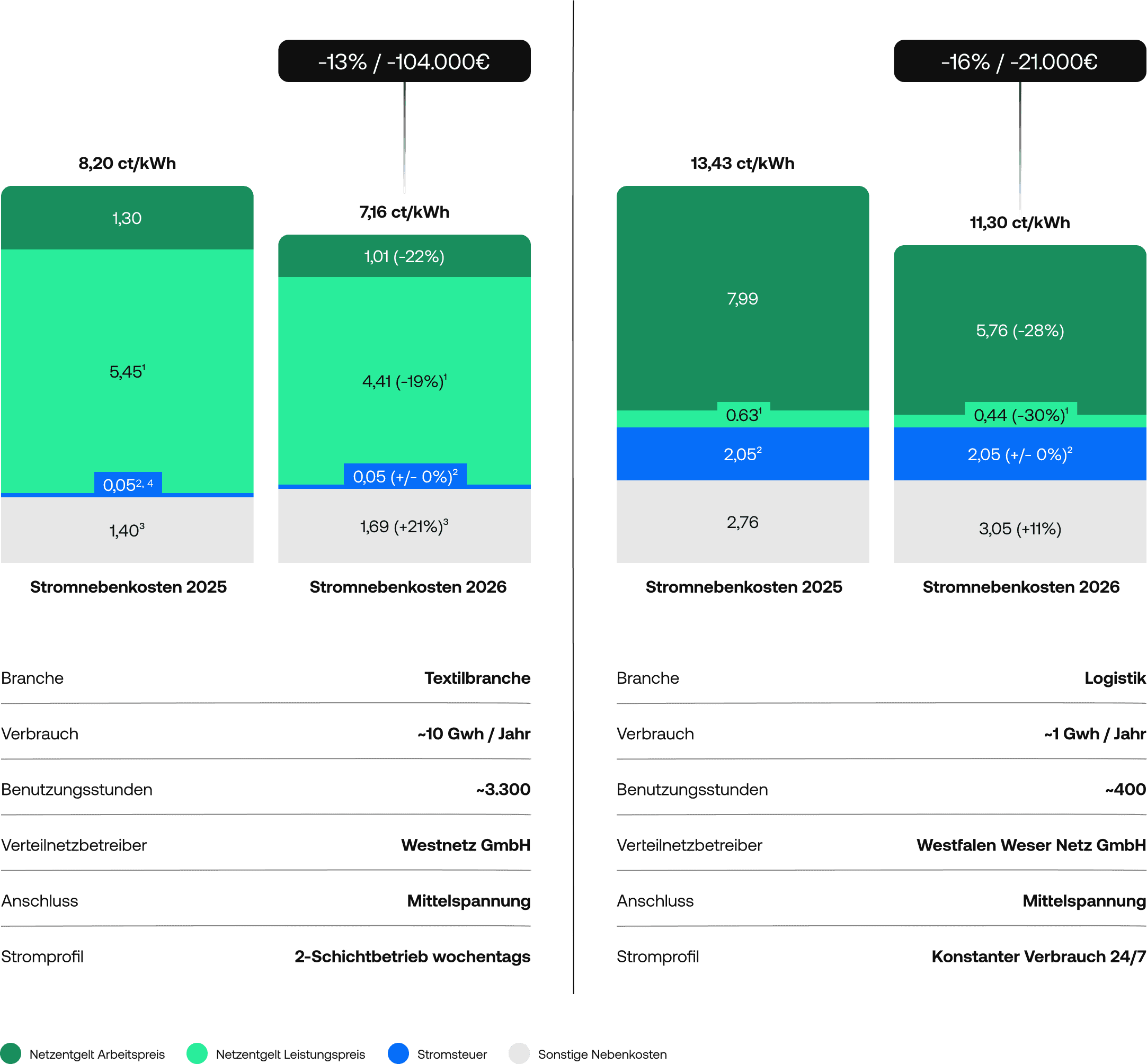
Our example calculation shows how different the relief can be depending on the sector, electricity consumption, load profile, and region or distribution grid operator. For instance, Example Company 1 benefits from around 13% lower electricity side costs, while Example Company 2 even achieves a cost reduction of 16%.
Note: Other side costs will rise significantly in 2026 compared to 2025 – by about 18%. This is mainly caused by higher surcharges, particularly the offshore grid surcharge and the CHP (KWKG) surcharge.
Simplified representation, demand charge depending on load peak
view AFTER tax refund
For the first GWh: 2.76 ct/kWh in 2025 and 3.05 ct/kWh in 2026 (due to the increase in the offshore and CHP surcharges), for each additional GWh: 1.25 ct/kWh in 2025 and 1.54 ct/kWh in 2026
The company already benefits from electricity tax relief in 2025.
Conclusion
With the electricity tax reduction, grid fee relief, and the industrial electricity price starting in 2026, the federal government is targeting three central drivers of electricity costs. However, even if the measures are an important signal, their impact remains limited: only some companies benefit directly from the electricity tax relief, and consumers also benefit from grid fee reductions to varying degrees, depending on the distribution grid operator. Companies should also not rely on the temporary industrial electricity price alone – as our separate specialist article shows.
This makes it all the more important to actively shape one's own electricity cost structure – through intelligent procurement strategies, load flexibility, and the use of data-based control. This not only mitigates risks but also exploits market opportunities and flexibility potential. trawa supports companies in implementing exactly that – pragmatically, measurably, and without additional staffing requirements.
We would be happy to analyze the impact of current regulatory changes on your individual company and the extent to which you can benefit from the relief.
Contact us – we are happy to assist you.
Sources:
https://www.handelsblatt.com/politik/deutschland/energie-wie-strompreise-die-deutsche-industrie-belasten/100176761.html
https://www.bundesregierung.de/breg-de/aktuelles/niedrigere-netzentgelte-2382396
https://www.bundesfinanzministerium.de/Content/DE/Pressemitteilungen/Finanzpolitik/2025/09/2025-09-03-massnahmen-niedrigere-energiepreise.html
https://www.tagesschau.de/wirtschaft/verbraucher/strompaket-entlastungen-verbraucher-100.html
https://www.tennet.eu/de/news/uebertragungsnetzbetreiber-veroeffentlichen-vorlaeufige-netzentgelte-fuer-2026
https://www.handelsblatt.com/unternehmen/energie/energie-milliarden-fuer-die-stromnetze-wo-bleibt-die-entlastung/100175441.html
https://www.bundestag.de/dokumente/textarchiv/2025/kw46-de-energiesteuer-1126268
https://www.bundesregierung.de/breg-de/aktuelles/senkung-energiepreise-haushalt-2358526
Updates