Battery storage
Battery Storage: The Key to Self-Sufficient & Affordable Energy for Businesses

Written by:
Julia Buchterkirchen

Interesting facts about battery storage and its functions
Battery storage systems are electricity storage devices: they can flexibly absorb electricity and release it again when needed, thus serving as a storage solution for homes, as energy storage for commercial purposes, or as a storage power plant for energy supply. Their location of use and purpose determine the size of the battery storage and its design. Depending on the intended use, there are batteries with different storage capacities.
There are also differences in performance, i.e., the speed at which battery storage systems release energy again. Battery storage systems perform important functions for the energy transition, the integration of renewable energies, and the transformation of the energy system.
They can also help balance the supply and demand of electricity, perform various tasks in the power grid, and provide system services such as frequency regulation, synthetic inertia, or black-start capability.
Their services can be offered on various markets. These include markets for system services, capacity markets, or wholesale electricity markets. The output of battery storage systems can thus be used and marketed in different ways. Depending on the type of application, battery storage systems are configured and must meet specific regulatory requirements.
Design and components of battery storage systems
Battery storage systems consist of various components. These include the following:
Battery Management Systems:
As the control center of a battery storage system, they regulate the charging and discharging of the battery.
They ensure optimal performance by controlling the respective intake or output of electricity.
Power Electronics:
This includes rectifiers and inverters. For example, they convert the direct current generated by PV systems into alternating current so that it can be used locally or fed into the power grid.
Measurement and Communication Technology:
Digital communication media form the information basis and serve to collect data,
which is forwarded to grid and plant operators via a smart meter gateway.
Specialized Software for Market Participation:
To market the output of battery storage systems, specialized software solutions are required.
These ensure that the battery storage system can be controlled and that real-time data is transmitted to marketers in order to trade available capacities. The battery storage system can thus also be used for arbitrage trading on the wholesale market.
In the interplay between generation and consumption, battery storage systems and intelligent controls assume important functions. This opens up new revenue options, making it possible to earn money from volatility in the electricity market.
Current state of technology and market situation
Storage technology has developed rapidly in recent years. Today, there are numerous different battery storage systems on the market. However, these storage solutions differ in terms of their state of technology and the possibilities for commercial viability.
Lithium-ion batteries
The greatest breakthroughs in recent years have been achieved in lithium-ion battery storage technology. Lithium-ion batteries are characterized by a long service life and a very high efficiency rate. This is around 95 percent. They can release almost all of their stored energy.
Lithium-ion batteries are widespread and have become indispensable in smartphones, tablets, or laptops.
Similarly, they are currently used for electric vehicles such as e-bikes, e-scooters, or electric cars.
Another major area of application for lithium-ion batteries is the integration of renewable energies, and thus the stationary electricity storage market.
However, serious disadvantages of lithium-ion battery storage technology are its environmental impact, as well as the difficult access to and extraction of the raw material lithium.
Sodium-ion batteries
Sodium-ion batteries are similar in design to lithium-ion batteries. However, they do not require the critical raw material lithium. On the other hand, their energy density is lower. They are particularly suitable for stationary use.
As this technology is still quite young, further technological leaps,
economies of scale, and falling prices can be expected in the future.
Sodium-sulfur batteries
Sodium-sulfur batteries have a high energy density. They are characterized by
durability and reliability. In addition, they are considered operationally safe.
However, they are expensive and require specific conditions to be able to store large amounts of energy.
Lead-acid batteries
Alongside lithium-ion batteries, lead-acid batteries are also very widespread. They have been around for a long time and have proven themselves in a wide range of applications. They do not require critical raw materials and are inexpensive. However, lead-acid batteries are also significantly heavier and larger than lithium-ion batteries.
They have a shorter lifespan and a lower efficiency rate. This lies at around 80 percent.
Redox flow batteries
Unlike solid-state batteries, redox flow batteries use liquid electrolytes to store energy. The electrolytes are stored in tanks outside the battery cell. Here, they convert electricity into chemical energy. Therefore, output and capacity can be determined freely and independently of each other.
This allows redox flow batteries to be configured for different applications and to exceed the lifespan of lithium-ion batteries.
However, the technology is still in the developmental stage, and various electrolytes are still being researched. For the future, they promise versatile application options because they are suitable for both short- and long-term energy storage, making them highly versatile and flexible.
Since companies and research institutions worldwide are working on battery storage, further technological leaps and improvements in storage technology can definitely be expected.
For practical application, the mature battery storage technologies are currently the most suitable. When choosing the respective battery storage technology, the purpose, application case, and prevailing market conditions must be taken into account.
Benefits of battery storage for commerce and industry
In the future, battery storage systems will make an important contribution to grid stability and are therefore a key element for the transformation of our energy system.
For companies, battery storage is already a sensible addition today when it comes to self-supply
of electricity.
Furthermore, they offer various marketing options for the stored electricity. Companies can therefore benefit in any case from investing in battery storage systems.
The following benefits apply to commercial enterprises and industrial companies using battery storage:
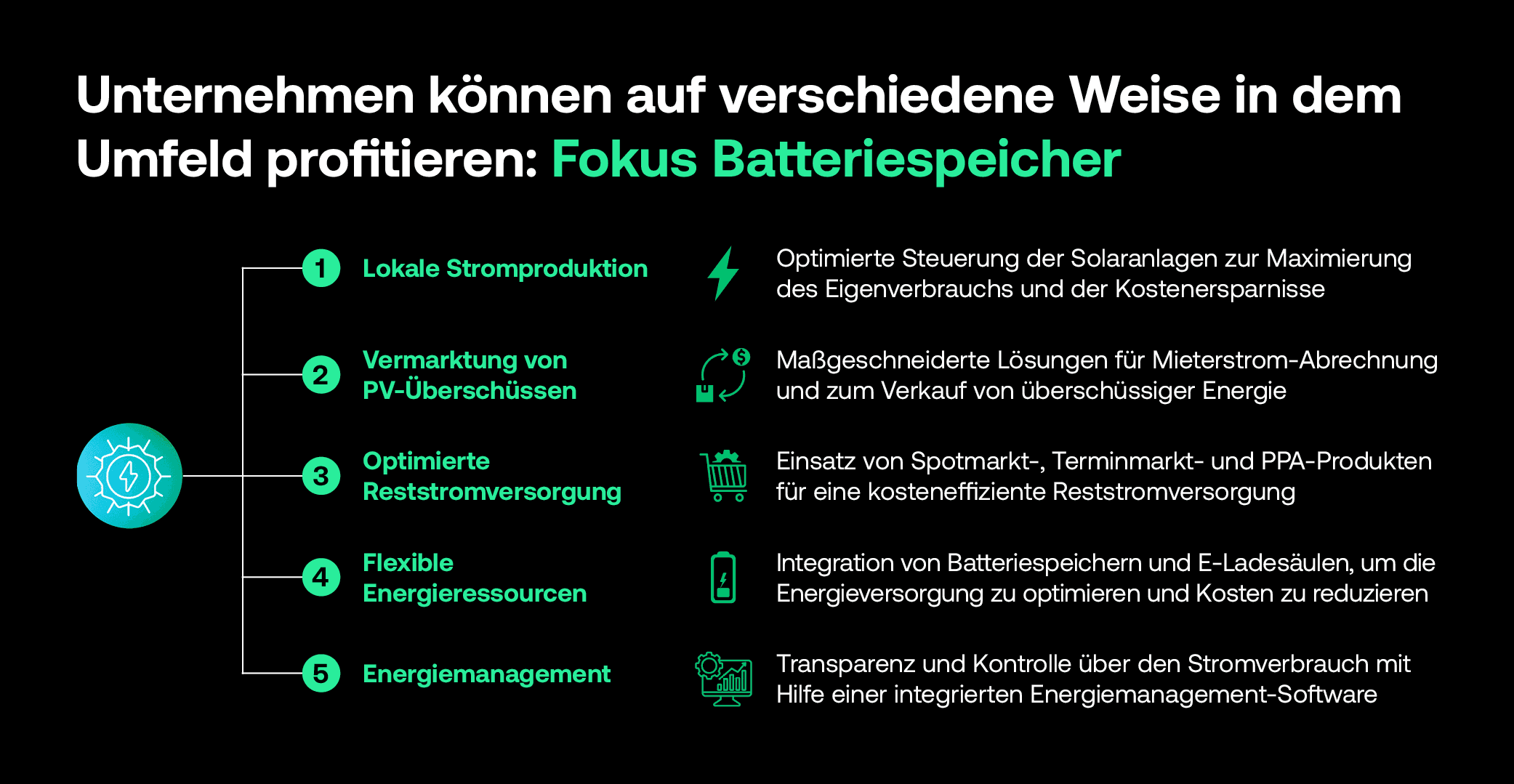
Local electricity production
Through optimized control – for example of solar systems – companies can use
battery storage systems to maximize their self-consumption and thereby achieve significant cost savings. For example, this reduces network charges, which are a major component of the electricity price.
Marketing of surplus PV energy
By using tailored, intelligent software solutions, surpluses can be marketed
and additional revenue generated.
Optimized residual power supply
By using battery storage, companies can increase their self-consumption from renewable energies and thus buy less electricity from the grid. At the same time, battery storage supports the optimization of residual electricity purchasing from the grid through the use of software.
Flexible energy resources
By integrating additional electrical consumers, such as electric fleets and EV charging stations, companies can further optimize their energy supply and reduce energy costs. Flexible electricity consumption, for example by adjusting production times, also favors the purchase of cheap green electricity in companies.
Energy management
The use of energy management solutions helps to maintain clarity regarding electricity consumption, monitor it, and control it automatically.
Conclusion
Battery storage technology has made great leaps in recent years. Flexible battery storage solutions are available on the market, and prices for battery storage have fallen significantly.
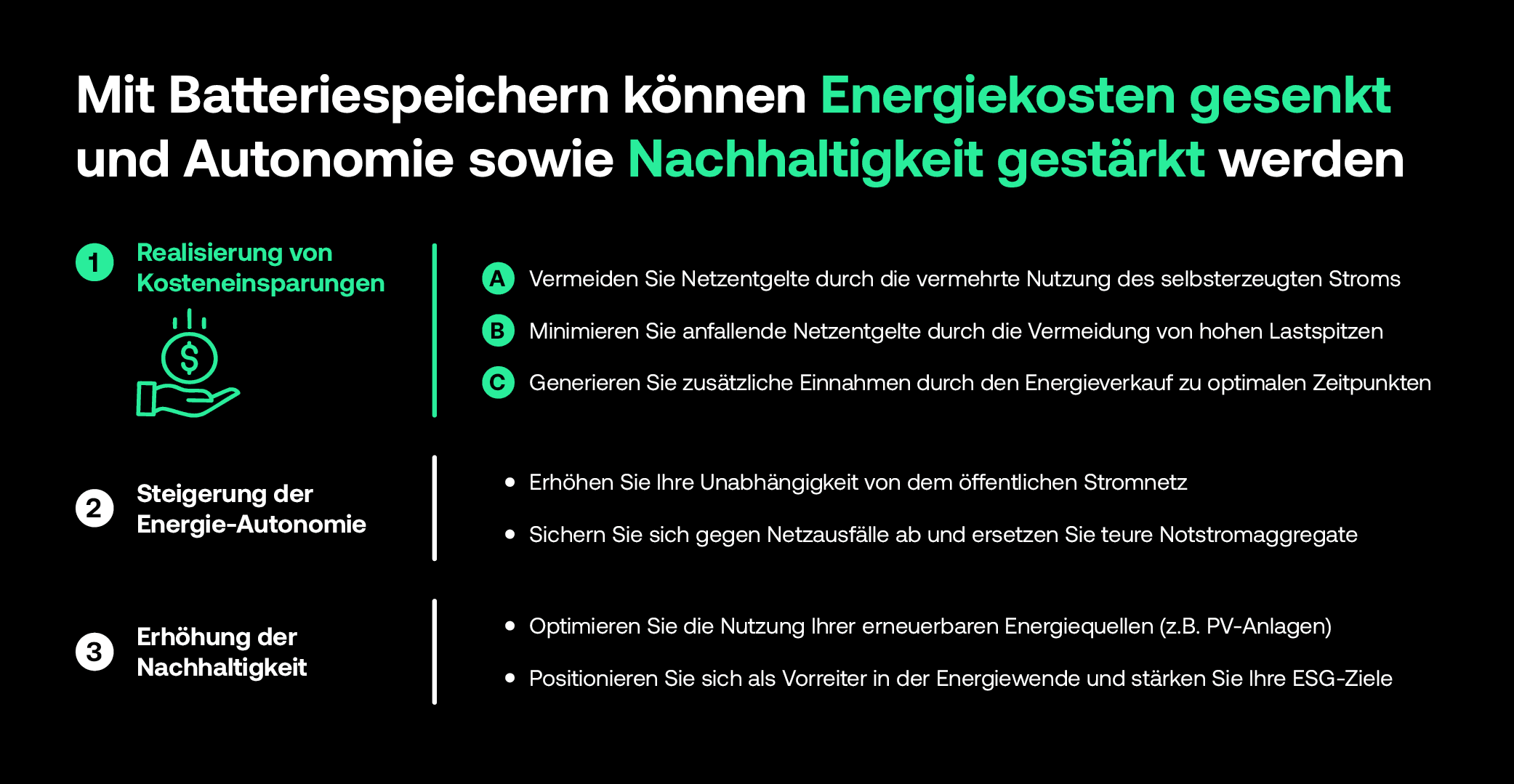
For commercial enterprises and industrial companies, this results in a wide range of benefits and usage options, as battery storage helps them make the best possible use of their self-generated green electricity and benefit from various marketing prospects.
This makes battery storage a central component of an integrated energy transition strategy, through which companies save energy costs, generate additional revenue, and make themselves more independent of electricity markets and energy suppliers.
Thus, there are solid reasons for industrial companies and commercial enterprises to invest not only in renewable energies, but also in battery storage.
Battery storage