Battery storage
Battery storage for businesses – reduce electricity costs by 15%

Written by:
Julia Buchterkirchen
The goal is to reduce energy costs while ensuring a stable, sustainable power supply. In this context, battery storage systems offer an excellent solution: they allow electricity to be used according to demand and provide an active hedge against fluctuations.
Commercial operations and industrial enterprises with high electricity consumption offer significant savings potential through battery storage. These savings can reach up to 15 percent. Furthermore, they offer companies new sources of income through various marketing options on the electricity markets.
What are battery storage systems and how do they work?
Battery storage systems store electricity from renewable sources, such as solar or wind energy, and release it when needed. This allows companies to absorb excess and cheap electricity and use it during times when prices are high or when internal demand rises. An intelligent energy management system controls the energy flow, meaning that expensive load peaks can be shaved and grid fees lowered.
The market for battery storage: Falling prices and attractive subsidies
In recent years, the costs of battery storage systems have dropped by around 90%. This decrease in price is mainly due to technological advancements and the expansion of production capacities. At the same time, numerous state subsidy programs further facilitate the investment. This means that investments in battery storage, which were not lucrative just a few years ago, can be highly profitable today.
The following 3 trends are emerging:
The share of renewable energy is growing. Currently, it stands at nearly 62 percent and is projected to rise to around 80 percent by 2030.
With fluctuating energy production, volatility also increases.
As a result, there will be an oversupply on sunny and windy days more and more often, which leads to negative prices on theelectricity markets or results in risk premiums for fixed-price offers.
Battery storage systems cushion such peak loads. At the same time, they offer lucrative income and marketing options.In recent years, prices for battery storage systems have fallen by around 90 percent.
The reasons for this are technological advances in battery storage technology as well as the expansion of production capacities and resulting economies of scale.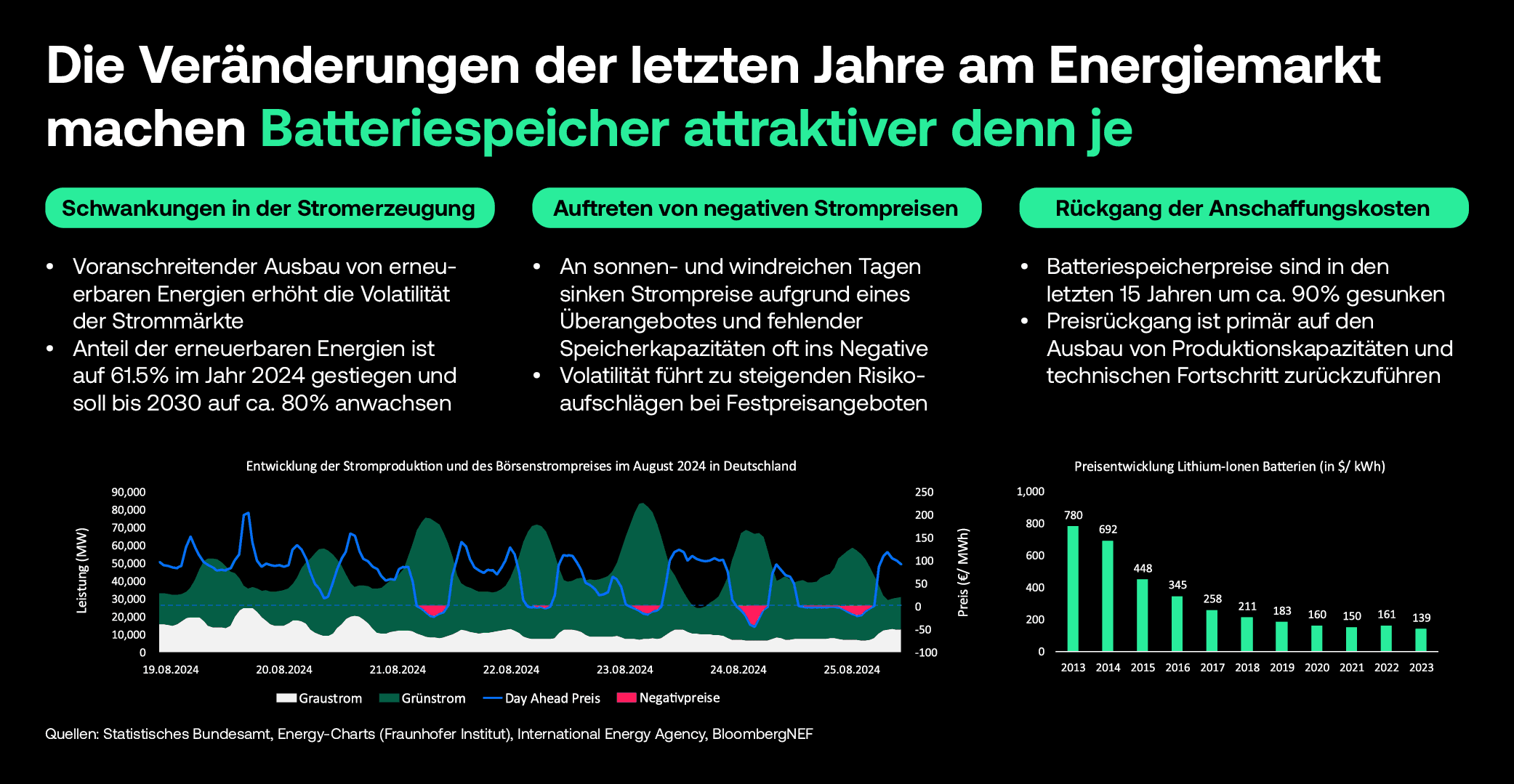
Lower grid fees and energy costs, more autonomy and sustainability
With battery storage systems, you can reduce your energy costs and strengthen autonomy and sustainability.
Avoid grid fees through increased use of self-generated electricity
With a battery storage system, self-consumption from your own power generation can be maximized,
replacing expensive power purchases from the grid. Especially on days with high solar radiation
or strong wind, the system can produce more electricity than is consumed immediately. This electricity
can be stored and used as needed.
Strengthen autonomy and grid independence
Companies with high electricity consumption can increase their energy autonomy through battery storage. For example, by consuming self-generated electricity from renewable energy systems first instead of expensive grid electricity, or by drawing power from the grid whenever it is particularly cheap. This reduces dependence on the electricity market and helps cushion fluctuations in energy costs.
Secure sustainability benefits
Battery storage systems help reduce CO2 emissions by facilitating the integration of renewable energies. In combination with solar or wind power systems, storage can significantly reduce the company's carbon footprint and improve its environmental record.
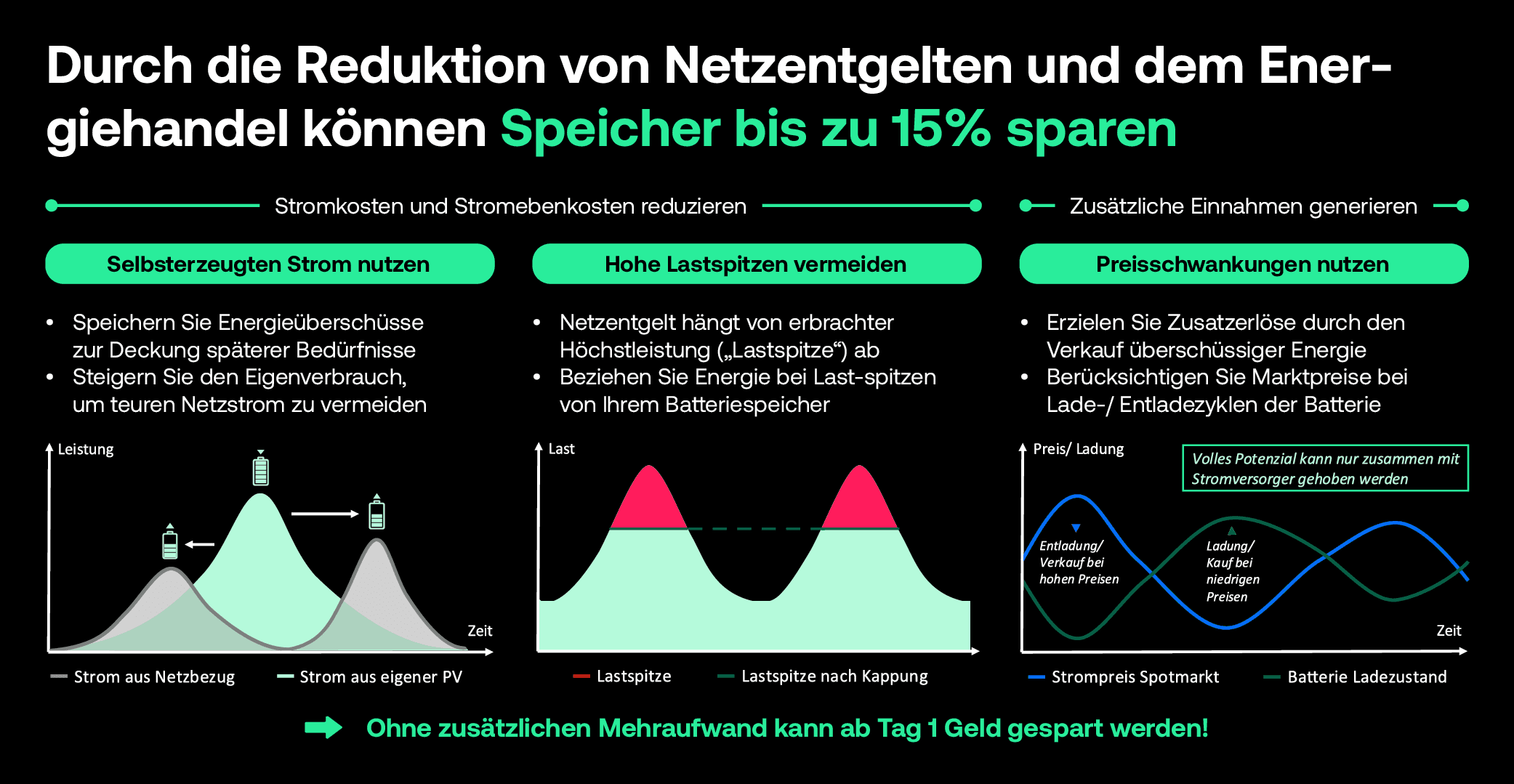
In the interplay between generation and consumption, battery storage and intelligent control assume important functions. This opens up new income options, making it possible to earn money from volatility in the electricity market.
Learn in this article "Why battery storage systems are an indispensable component of a cost-effective and autonomous energy supply for companies".
What factors influence the choice of the right battery storage system?
The decision for the appropriate battery storage system depends on several aspects, including:
Power consumption and load profile: Companies with high peak loads can achieve significant savings in grid fees by using a
battery storage system.Production of own renewable energy: Companies that already operate their own PV systems
can store excess electricity and thus further maximize self-consumption.
Physical conditions and willingness to invest:Depending on the location and budget, different types of storage, such as indoor or outdoor storage, can be used.
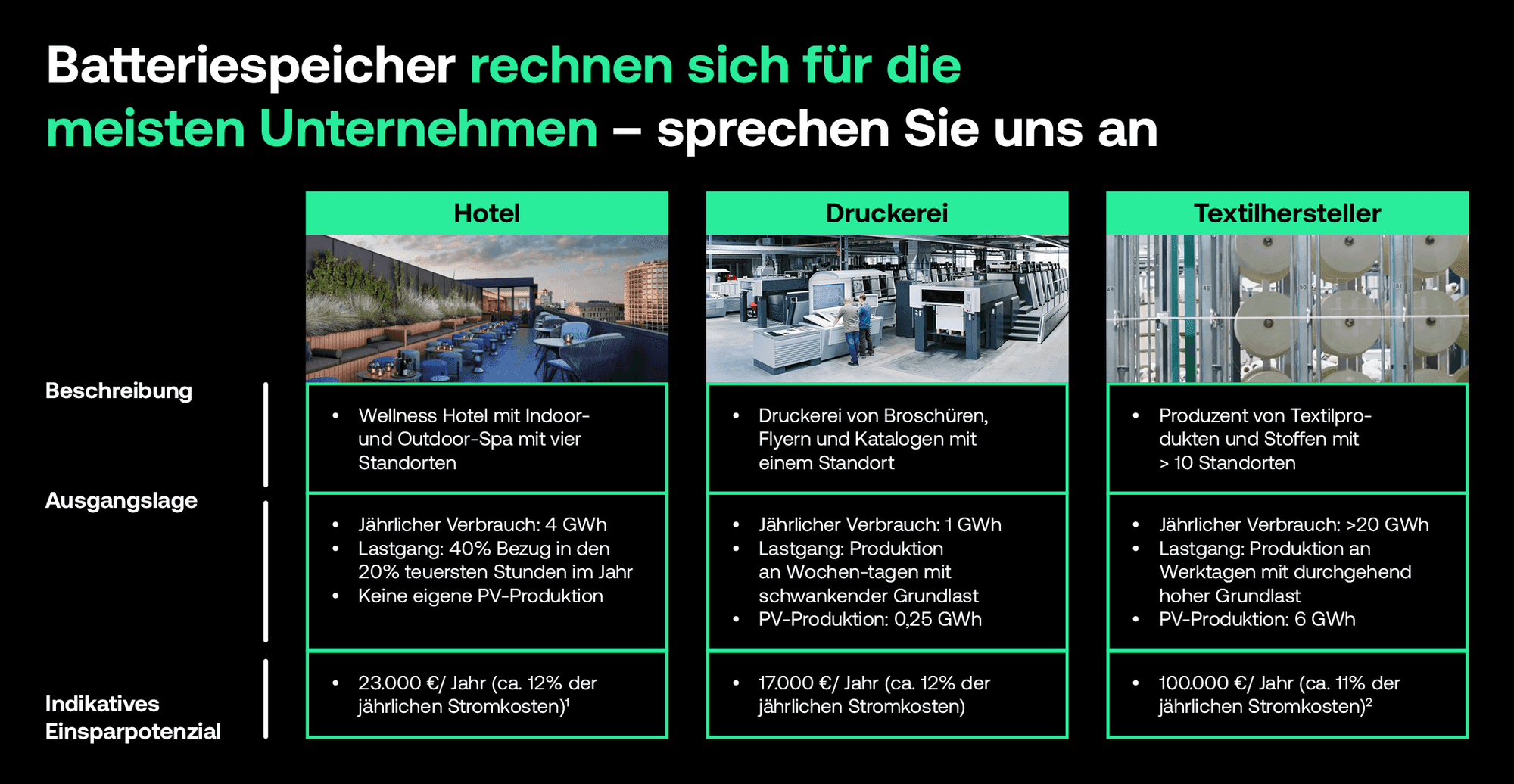
Our calculation examples illustrate the savings potentials for companies from different industries:
Battery storage for companies: A worthwhile investment in the future
Battery storage systems enable companies not only to save costs, but also to design their energy supply to be sustainable and crisis-resistant. With the right combination of energy management and storage technology, companies can reduce their operating costs and make their contribution to the energy transition.
Imagine if your company were not only more cost-effective, but could also react flexibly to market fluctuations – battery storage systems make this possible.
Battery storage


