Updates
Industrial Electricity Price 2026: How to effectively subsidize your battery storage and benefit twice overachieve doubly

Written by:
Linda Elberskirch
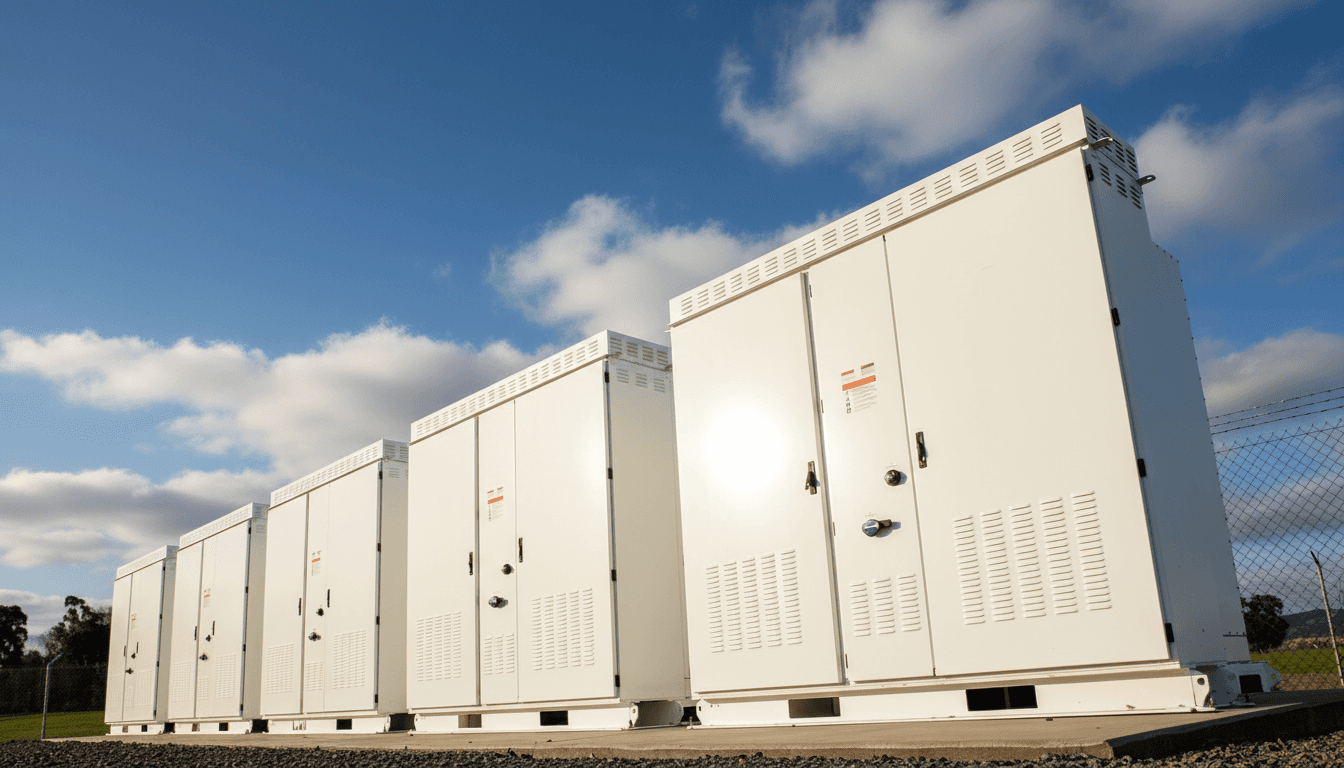
Around 30% cost reduction with the industrial electricity price through clever reinvestment
The industrial electricity price is a temporary state relief for energy-intensive companies on the so-called KUEBBL list
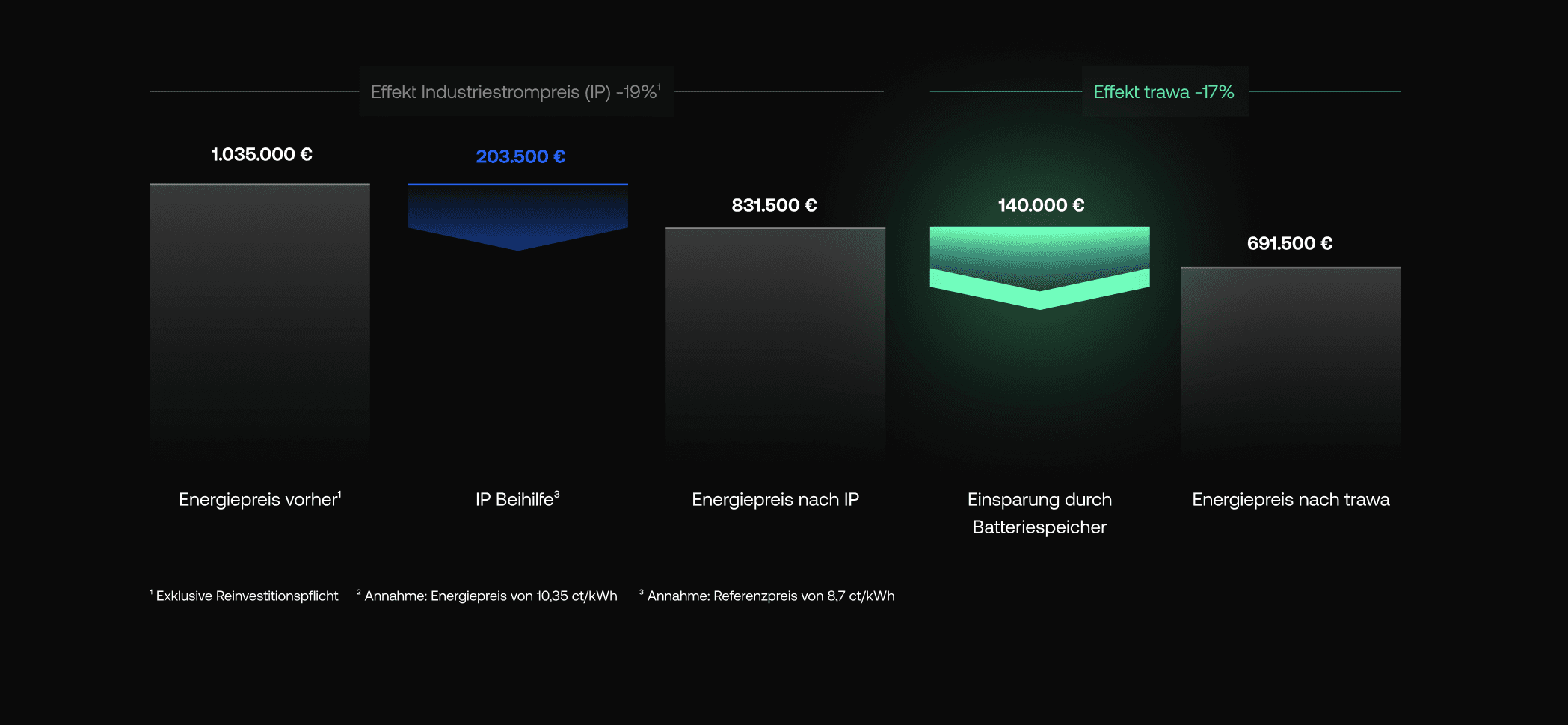
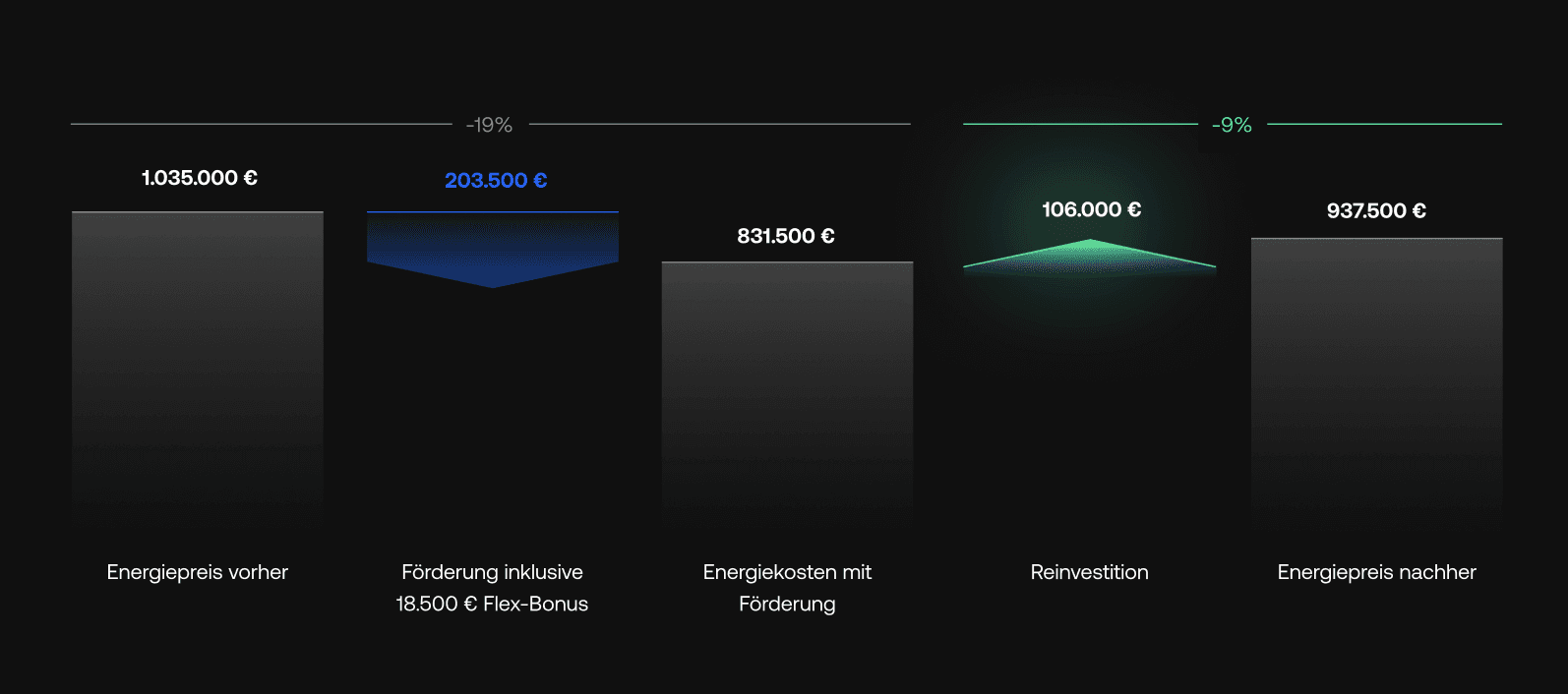
The example calculation below shows that with full utilization of the industrial electricity price, energy costs can be reduced by approx. 19% - corresponding to approx. €203,500 for an example company with 10 GWh (with a different company size, corresponding higher or lower absolute savings)
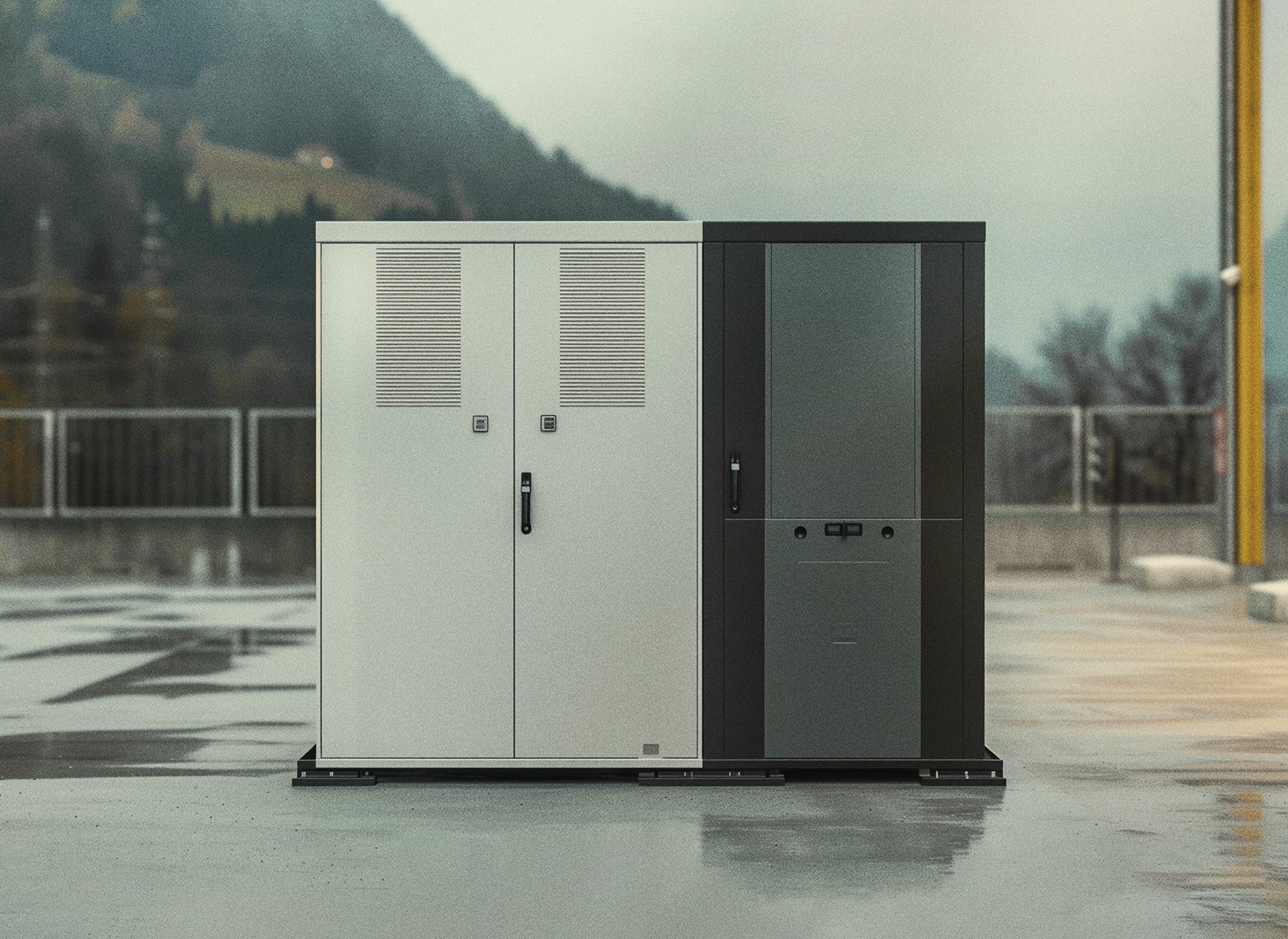
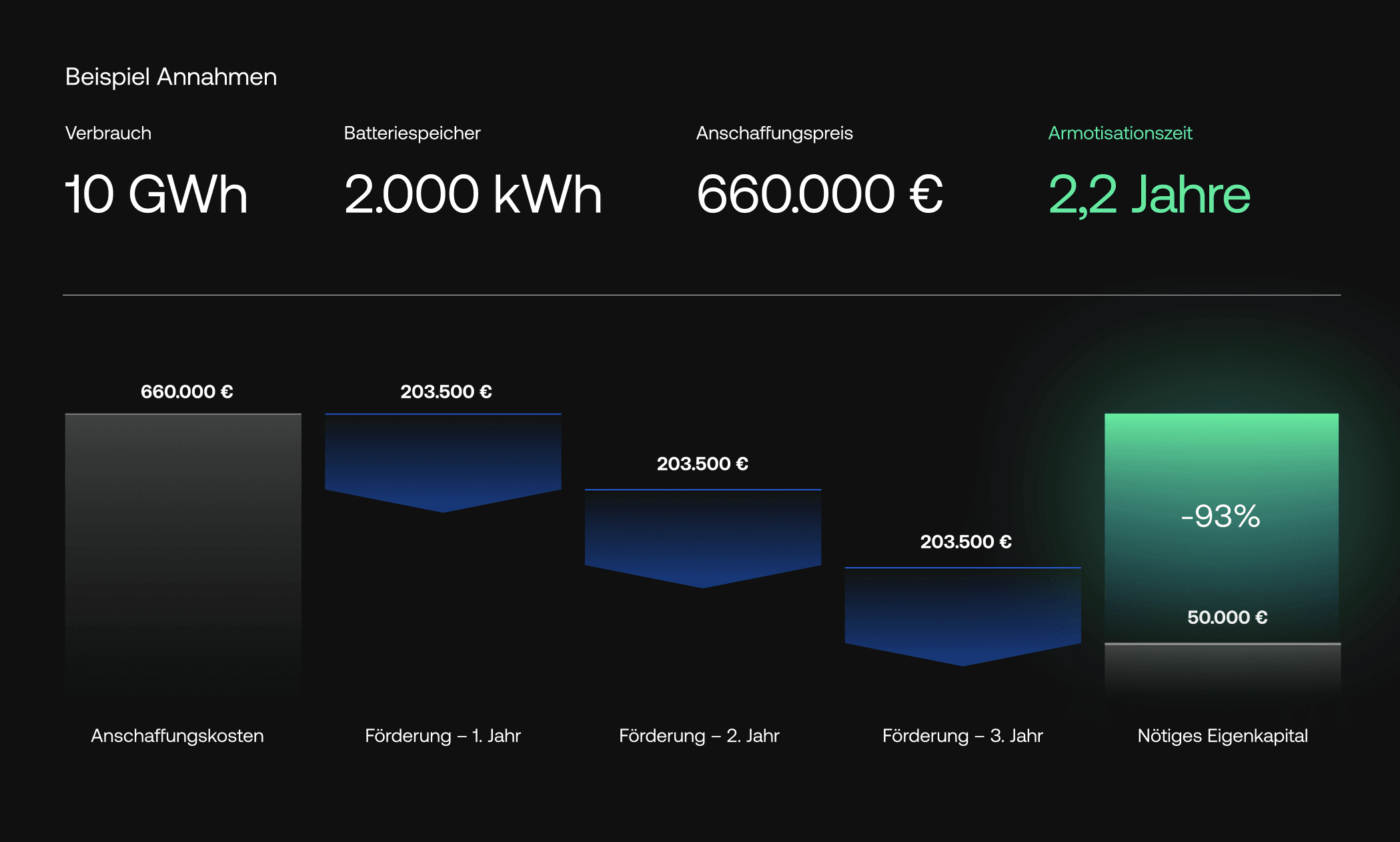
If the aid is fully reinvested in purchasing a battery storage system, >93% of the investment costs can be covered by the funding - with a payback period of up to 2.2 years
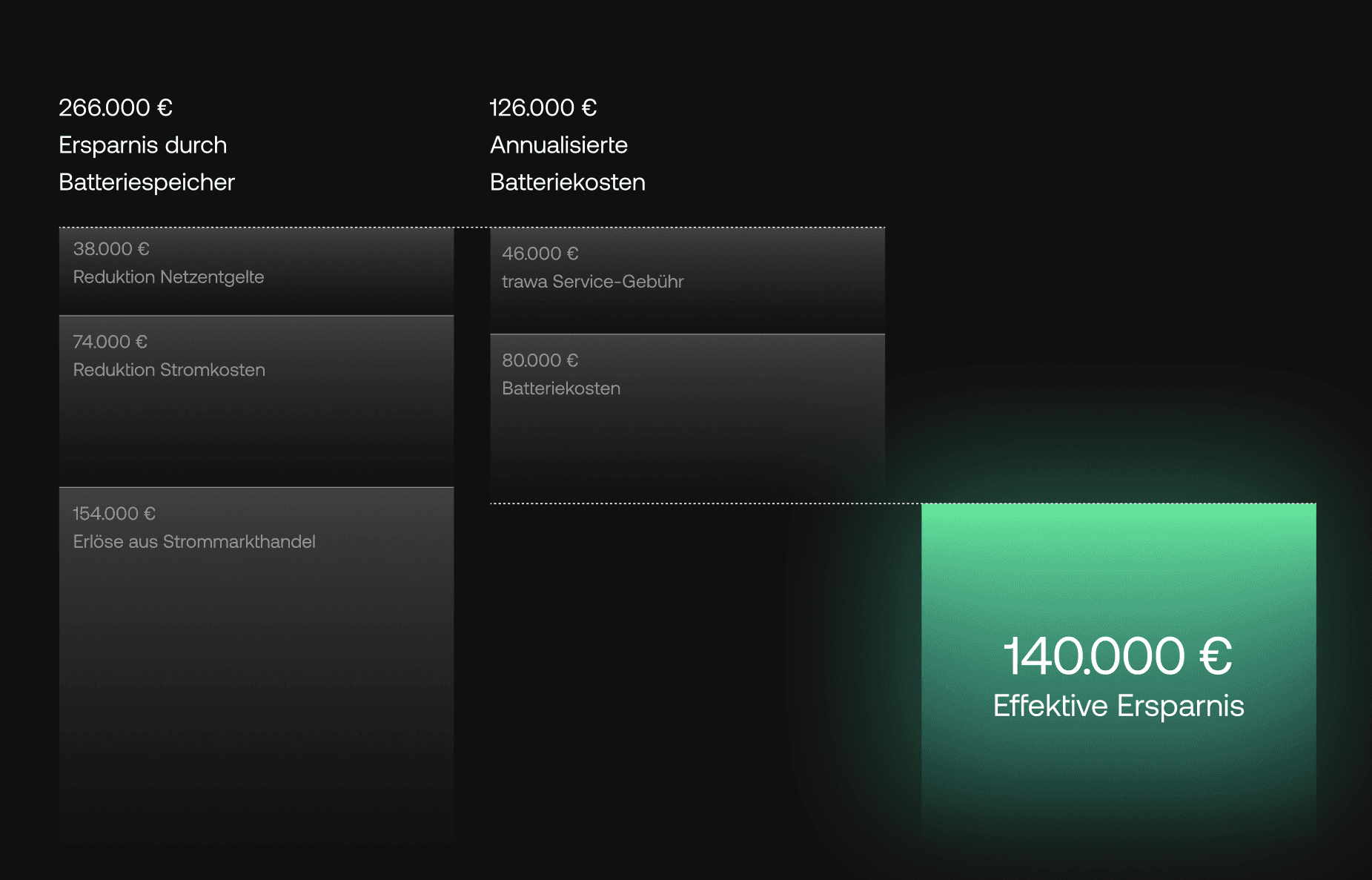
The battery storage reduces costs permanently by another 17% - corresponding to approx. €140,000 for an example company with 10 GWh - also beyond the duration of the industrial electricity price
With further measures, such as optimized electricity procurement, additional costs can be saved
trawa supports the entire process: from analyzing eligibility for funding to implementing the battery storage and optimizing electricity procurement
Temporary state relief through the industrial electricity price for 50% of consumption
The industrial electricity price is a temporary state relief intended to apply from 2026 to 2028. Its aim is to secure the competitiveness of energy-intensive German companies, preserve locations and jobs, and accelerate decarbonization through a reinvestment obligation.
The industrial electricity price in brief
The industrial electricity price is a temporary state relief. The aid framework is based on the EU's Clean Industrial Deal State Aid Framework (CISAF), which allows discounts of up to 50% of the wholesale price on up to 50% of consumption, with a minimum price of 50 EUR/MWh (5 ct / kWh). The aim is to secure competitiveness, preserve locations and jobs, and accelerate decarbonization through a reinvestment obligation.
Pricing — Reduction of the average annual wholesale price (reference price) by 50% with a lower limit of 5 ct / kWh.
Quantity limit — Reduction for a maximum of 50% of the annual electricity consumption.
Quid pro quo — Reinvestment of at least 50% of the aid amount received in climate protection & energy efficiency measures within 48 months. Measures include: energy storage, renewable generation capacities, demand flexibility, energy efficiency, electrolysers, and electrification.
Flexibility bonus — The aid can be increased by 10% if the majority of the quid pro quo flows into demand flexibility. However, 75% of this must be reinvested back into quid pro quo measures.
Refers exclusively to energy procurement — Grid fees, levies, charges, and taxes are extra.
Application process — Can (presumably) be applied for retroactively at the BAFA.
Companies on the so-called KUEBBL list benefit
Eligible are companies from the sectors on the so-called KUEBLL list (EU Carbon Leakage List). This list includes energy-intensive industries that are at an increased risk of shifting production abroad.
This includes 91 (sub-)sectors, including chemical, metal, glass/ceramics, cement, paper/plastics, battery cells, semiconductors, as well as areas of mechanical engineering and raw material extraction. Affiliation is checked via the WZ code, and the inclusion of further sectors is currently still being discussed. Currently, there is a double funding ban regarding other aid. This means that the industrial electricity price cannot be used in addition to, for example, electricity price compensation. This is expected to make the funding less interesting for particularly large companies, thereby increasing the level of support for medium-sized businesses.
Privilege by sector affiliation
The EU has defined 91 sectors that are particularly threatened by high energy costs. There is no minimum size and no minimum consumption. How to easily find out if you can benefit from the industrial electricity price:
Access the latest KUEBLL list, e.g., here.
View "Sub-list 1" in the PDF (page 84). Note: Further sectors may still be added.
Match your NACE/WZ code (4-digit) with yours. You can find your NACE/WZ code, for example, in the business register or here.
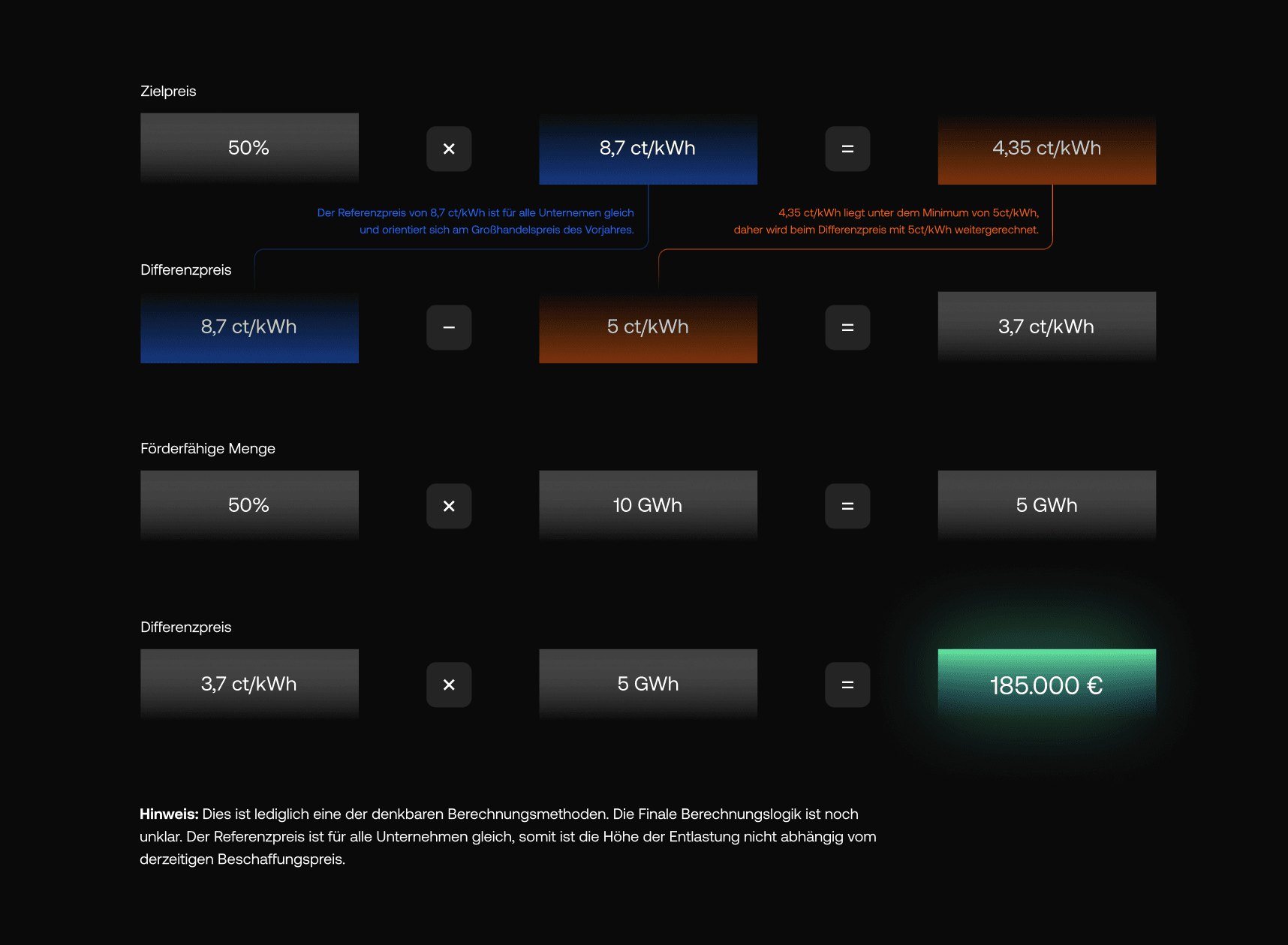
€185,000 savings with 10 GWh consumption and 8.7 ct / kWh reference price
What does all this mean specifically for an industrial company with a consumption of 10 GWh? With a reference price of 8.7 ct / kWh, it means a relief of approx. €185,000, as shown in the example calculation:
10% bonus for reinvestment in battery storage
The reinvestment obligation turns to your advantage. 50% of the relief, i.e., €92,500, must be reinvested in climate protection and energy efficiency measures. If invested in measures to increase demand flexibility – such as battery storage – a so-called flexibility bonus can be granted. In this case, the company receives an additional 10% of the aid, i.e., €18,500. Of this amount, 75% must in turn be invested as a quid pro quo, which corresponds to €13,875, so that the total reinvestment increases to approx. €106,000.
Aid finances >93% of the battery storage with <2.2 years payback period
If the released capital of €203,500 per year in our example – i.e. ~€611,000 over three years – is fully invested in a battery storage system, this can be subsidized to over 93% with a capacity of 2,000 kWh and investment costs of around ~€660,000. This pays off quickly: amortization would be possible here in just 2.2 years.
Permanently lower costs through battery storage
A battery storage system is not only worthwhile because of the funding: it permanently reduces energy costs – even beyond the duration of the industrial electricity price. In the first year alone, costs in the example can be reduced by an additional ~€140,000. The economic advantage arises from:
Lower grid fees: by targeted discharging of the storage system during peak load times to avoid expensive power prices in grid fees (peak shaving).
Lower electricity costs: thanks to price-optimized charging in low-price periods as well as by optimizing self-consumption (storage of excess solar power and time-shifted consumption).
Additional revenue: by marketing free storage capacity on the short-term electricity market (trading yields on the intraday market).
What are the conditions for an industrial electricity price?
Companies must invest at least 50% of the aid received in decarbonization measures within 48 months of the aid being approved. This includes energy storage, demand flexibility, electrification, self-generation from renewable energy, efficiency measures, and new PPAs for new renewable energy installations.
Implementation of the intended quid pro quo measures may begin after the start of the billing year. This means: anyone applying for the industrial electricity price for 2026 can initiate the required measures directly in parallel with the application.
The aid amount is increased by 10% if the company proves that at least 80% of the quid pro quo obligation is invested in measures to increase demand flexibility. Of this flexibility bonus, at least 75% must in turn be reinvested in quid pro quo measures.
The specific conditions are still being discussed in detail as part of the notification process with the European Commission.
Double savings: Optimized energy procurement with trawa
In addition to the industrial electricity price and the use of battery storage systems, companies can permanently reduce their energy costs through an optimized electricity procurement strategy. This also applies to companies that do not benefit from the industrial electricity price.
Based on individual electricity consumption, trawa's AI-based software creates a customized portfolio of direct supply contracts with German wind and solar parks (Power Purchase Agreements), futures market procurement, and daily exchange purchases.
Depending on the previous procurement strategy and market situation – particularly compared to fixed-price models – additional savings of up to 15% are possible – and with 100% renewable energy. Similar to an ETF savings plan, companies benefit from market movements and turn price fluctuations into a long-term advantage.
Conclusion
The industrial electricity price provides energy-intensive companies with noticeable financial relief – initially for a period of three years. Those who use this opportunity and the reinvestment obligation cleverly can turn the temporary aid into sustainable competitive advantages.
With the combination of funding, battery storage, and optimized electricity procurement, over 30% of energy costs can be saved – and a large part of these savings remains effective permanently beyond the duration of the industrial electricity price. Depending on the model, a battery storage system can be funded up to over 90% and amortized in about two years.
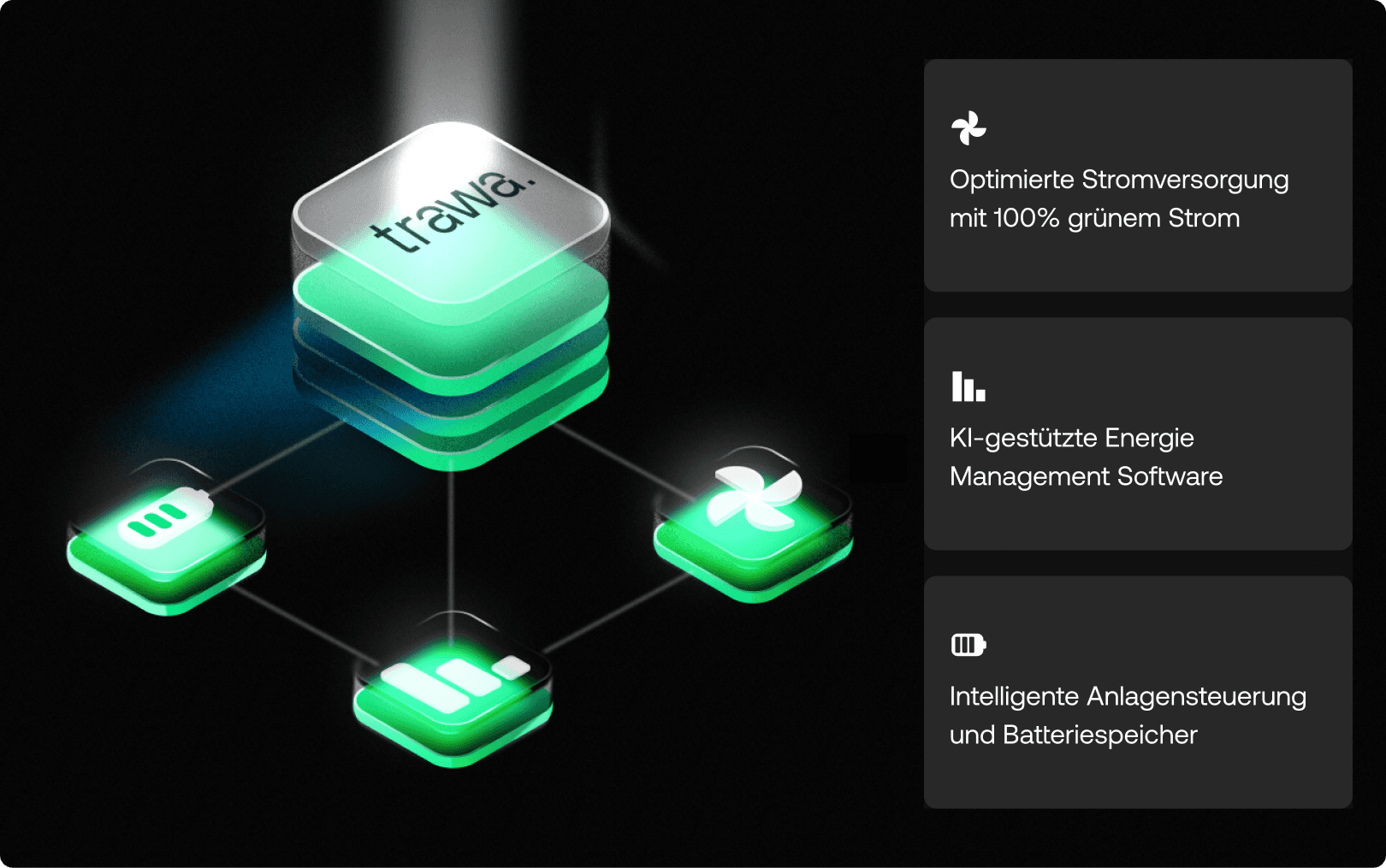
trawa supports companies holistically – from funding analysis and application submission, to implementing the battery storage through to strategic optimization of electricity procurement. This is how short-term relief becomes a long-term cost strategy.
Act now instead of waiting: Contact us – we are happy to support you.
Note: The industrial electricity price has been approved by the EU Commission. However, some implementation details are currently still being specified - this article is based on the current interpretation and is subject to change.
Updates