Electricity purchasing
Commercial Electricity Prices 2026: Reducing the Risk of High Prices with Direct Power Purchase Agreements and Dynamic Tariffs

Written by:
Anne Fischer

The past 5 years have made it clear: electricity costs have turned from a predictable expense into a serious risk for many companies – and a permanently high commercial electricity price can become an existential burden [2].
Geopolitical tensions and the expansion of renewable energies are creating volatile markets that have turned the price structures of electricity procurement upside down. This puts medium-sized enterprises in particular under pressure, for whom energy costs can determine their competitiveness [3][7].
Those who compare electricity solely based on a fixed price often overlook the advantages of structured procurement, dynamic tariffs, and direct power purchase agreements – and pay more in the long run. Why this is so and how dynamic tariffs and direct power purchase agreements – so-called Power Purchase Agreements (PPAs) – can help is the subject of this article [1].
Two important levers are presented with which companies can:
Actively reduce their energy costs,
specifically manage risk in procurement, and
set themselves up for long-term, low-cost operations independently of market forecasts.
A fixed price has a clear advantage: it is predictable. Entrepreneurs and buyers know exactly what they will pay at the start of the contract term and can calculate accordingly. However, this predictability comes with a catch.
Fixed Price: Convenient, but with Hidden Costs
Those who buy electricity exclusively at a fixed price lock in their entire demand for the duration of the contract at the price level of the purchase time. This gives customers two major advantages: a guaranteed price per kWh and no effort until the next contract concludes [6].
However, suppliers charge a premium for this purchased security – and these costs are added to the buyer's energy costs.
Risk Premiums as a Cost Factor
With fixed prices, sellers deliberately calculate the risk of a rising commercial electricity price. These risk premiums have risen significantly in volatile markets over recent years. The result: structurally, the fixed price is often above the average market level [3].
Fixed Prices Miss Opportunities from Market Fluctuations
A major disadvantage of fixed-price contracts: customers cannot make use of the fluctuations on the electricity market, which dynamic tariffs enable [6].
Buying on the Spot Market as an Alternative
Medium-sized businesses that decide to buy electricity directly on the spot market take on a higher risk of an expensive commercial electricity price, but at the same time benefit from the opportunities of low and negative energy costs.
The price on the spot market fluctuates hourly and is set daily for the following day, depending on how much electricity is currently available in the grid and how high demand is. Those who shift their consumption to cheaper hours – during times with plenty of available electricity from renewable energies – can significantly cut costs as a result.
Fixed Prices and Spot Market Prices in Comparison
The numbers speak for themselves. A comparison of the EEX spot and futures market prices from the years 2023/24 shows: although the dynamic price (spot market) fluctuates throughout the year, on average it is noticeably below the average fixed price [2][7].
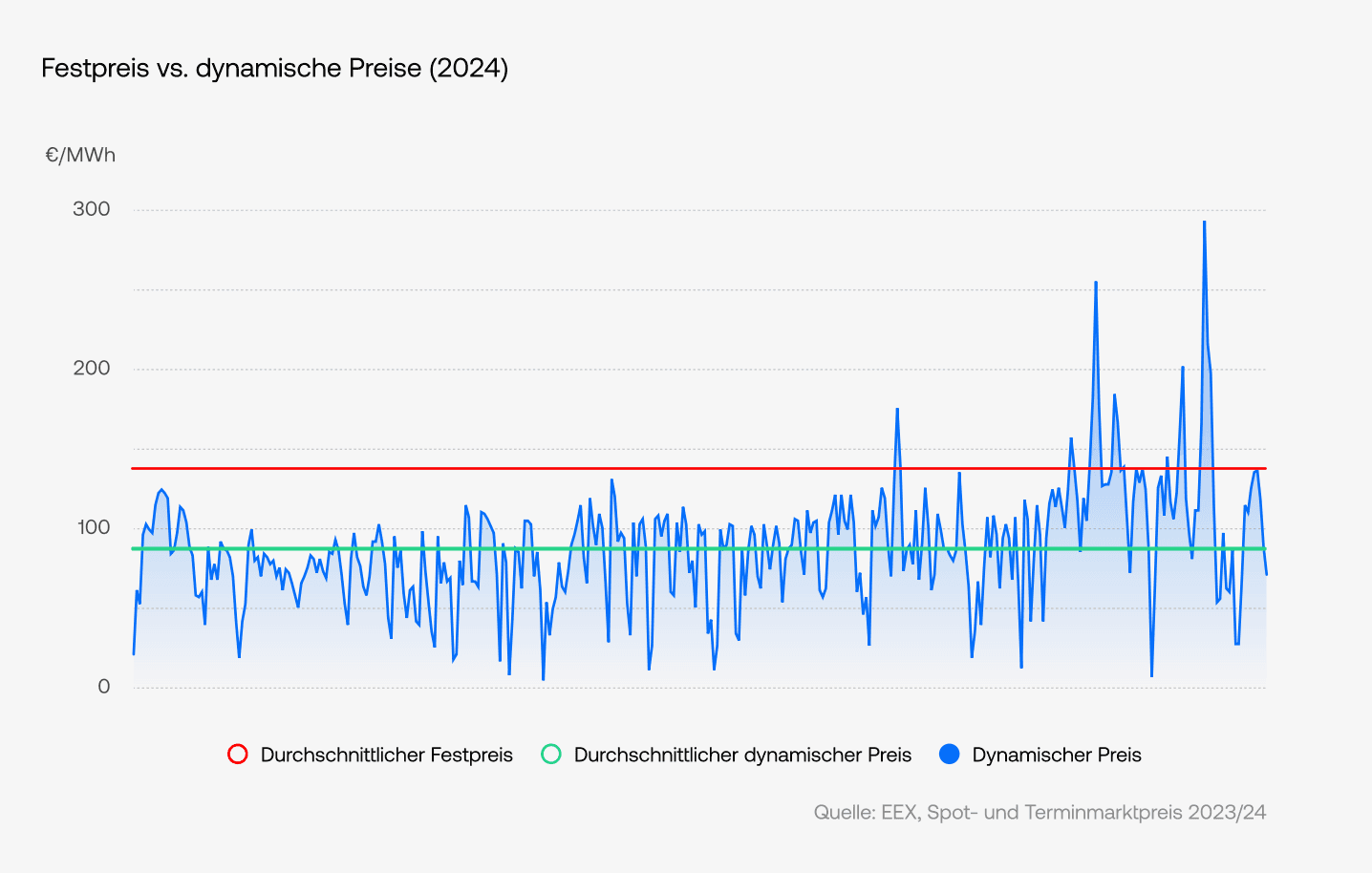
In addition to the lack of risk premiums, this is due to periodically highly negative prices resulting from a regular oversupply of available electricity from renewable energies in the grid. Companies that merely check the price and sign a fixed-price contract simply miss out on this cost benefit.
Professional Purchasing Structure with Dynamic Portions
Instead of a single fixed price or a spot market tariff, companies can also choose a mixed portfolio: the so-called dynamic portfolio approach – an increasingly popular alternative for lowering energy costs. In this approach, fixed components are combined with variable price components.
Structure and Advantages of Portfolios
Such a portfolio can consist of direct power purchase agreements with wind and solar farms (Power Purchase Agreements – PPAs), hedging on the futures market, and a flexible portion via the spot market. We will look at the impact of these Power Purchase Agreements in more detail in a subsequent section.
Under this dynamic portfolio, larger quantities are secured long-term during phases with a cheap price. In expensive phases, procurement deliberately remains flexible to cover a portion on a short-term basis. This smooths out cost fluctuations, makes the average commercial electricity price cheaper, and allows companies to profit from market movements instead of suffering from them.
Staggering Purchases Over Time Is Key
What is particularly important here is the staggering over time. Purchasing is not set at a single point in time. Instead, volumes are locked in across different periods. Staggered purchasing reduces the risk of expensive "one-off" purchases and works similarly to an ETF savings plan: buying is done gradually, smoothing the average price over time.
Rule of thumb: Purchasing at multiple points in time reduces the risk of outlier electricity costs by up to 25%.
Source: trawa electricity market analysis [4].
Power Purchase Agreements as a Cheaper Module in the Portfolio
An important module for lowering the electricity price within a portfolio is Power Purchase Agreements (PPAs). These are long-term, direct power purchase contracts with wind or solar farms [1].
According to the dena PPA Market Analysis 2024, Germany has established itself as the second-largest PPA market in Europe, which shows how accessible this market has now become for German medium-sized businesses [1].
PPAs often offer cost advantages, reduce the risk of volatile prices, and stabilize the commercial electricity price of companies over several years – an effective protection against short-term market spikes. Another advantage: the expected generation profile from a direct power purchase agreement usually fits perfectly with the actual load profile of the medium-sized company.
The Basic Principle
In a Power Purchase Agreement, capacity is agreed upon, not a guaranteed amount of electricity. Since these are exclusively renewable energy sources that are difficult to predict, the actual amount of electricity delivered depends on wind and sun.
Power Purchase Agreement and Futures Market Products in Comparison
PPA electricity is often cheaper in terms of expected value than comparable futures market products because the buyer shares the production and profile risks [1]. Many companies target this price advantage by mixing Power Purchase Agreements into their portfolio as a low-cost module. Complemented by futures market or spot market products, the portfolio remains stable – achieving a better commercial electricity price without allowing the risks to spiral out of control.
Early Price Fixing Reduces the Risk of High Energy Costs by up to 50%
While medium-sized businesses can already lower electricity costs through staggered purchasing, price spikes can be avoided by securing prices early on the futures market. Signing a contract early and starting purchases well in advance of the delivery start helps to bypass price spikes and make costs more predictable.
The principle is simple: medium-sized businesses start buying their electricity several years before the delivery year – purchasing step-by-step over time. When prices are attractive, a larger portion is locked in for the long term. If prices rise, purchases are deliberately paused or only a small portion is hedged. This avoids expensive "all-or-nothing" decisions shortly before the start of delivery.
Securing Prices in the Future as a Leverage to Save
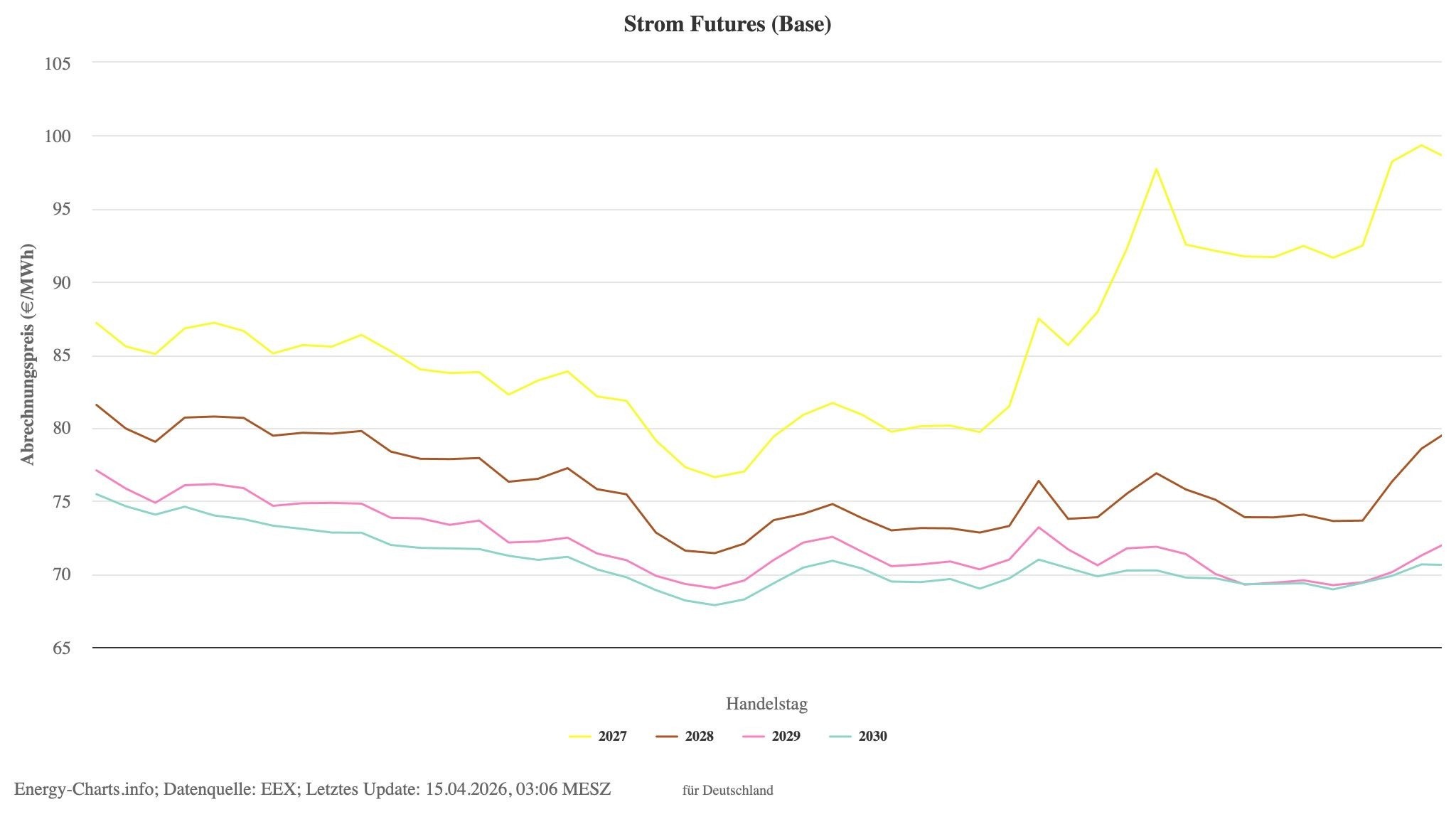
Another advantage: the further into the future that prices are locked in, the cheaper futures market products often are, and consequently the average commercial electricity price – as the following graphic shows [7]. For example, those who already secure portions for 2029 in Q1 2026 can specifically exploit this cost effect.
Those Who Only Compare Prices End up Paying More in Case of Doubt
Accordingly, a cheap commercial electricity price does not start with the cheapest provider. It begins with the right strategy and realistically calculated electricity costs. Those who think strategically about electricity purchasing save structurally and permanently – regardless of where the market moves next [3].
The Purchasing Strategy of Corporations is Now Used by Medium-Sized Businesses
Dynamic tariffs, staggered price-fixing, and Power Purchase Agreements are no longer tools reserved exclusively for major corporations. They are also accessible to medium-sized companies [1]. The difference compared to classic fixed-price contracts is clear and can add up to a cost reduction of up to 25% [4].
Further Levers for Cost Reduction
Dynamic tariffs and Power Purchase Agreements are just the beginning. The commercial electricity price can be reduced by up to 30% in total using further levers [4]. In the trawa whitepaper "Eight Ways to Save on Electricity: Out of the Price Spiral," these other 6 levers are introduced, allowing companies to lower their electricity costs sustainably and systematically – from intelligent plant control to utilizing state subsidies [5].
Download the free whitepaper "Out of the Price Spiral" here and lower your average energy costs.
Look for a Strong Partner for Implementation
Those who start early and professionalize their energy procurement with these simple steps reduce energy costs permanently. At the same time, independence from price spikes when buying electricity increases. This creates a lasting competitive advantage, especially for medium-sized businesses.
trawa is your partner for implementing these levers. To achieve a favorable commercial electricity price, trawa helps companies identify, economically evaluate, and optimally combine the right measures. To do this, trawa analyzes your load profiles, checks purchasing and contract structures, and prioritizes the biggest levers. This allows you to optimize your electricity purchasing and reduce electricity costs with trawa – by up to 30% [4]. And all that with electricity sourced 100% from renewable energies.
If you have any questions or would like a free potential analysis, the experts at trawa will be happy to assist you.
Please feel free to click here to use our contact form.
[1] dena (German Energy Agency), August 2025. PPA Market Analysis 2024. URL: https://www.dena.de/fileadmin/dena/Publikationen/PDFs/2025/PPA_Marktanalyse_2024.pdf
[2] Strom Report, 2025. Electricity Prices 2026 – RELIEF: Who really saves – and who only saves a little. URL: https://strom-report.com/strompreise/
[3] BDEW (German Association of Energy and Water Industries), April 2026. BDEW Electricity Price Analysis April 2026. URL: https://www.bdew.de/service/daten-und-grafiken/bdew-strompreisanalyse/
[4] trawa, 2025. Internal trawa Electricity Market Analysis. Unpublished.
[5] trawa, April 2026. Whitepaper: Eight Ways to Save on Electricity: Out of the Price Spiral. URL: https://www.trawa.de/wissen-insights/acht-wege-stromkosten-zu-sparen
[6] Strom Report, 2024. Electricity Prices for Businesses. URL: https://strom-report.com/strompreise/gewerbe/
[7] Energy Charts, April 15, 2026. Electricity Futures Base Germany. URL: https://www.energy-charts.info
Electricity purchasing