Electricity purchasing
Energy Procurement 2026: How SMEs Can Leverage New Market Opportunities for Low Electricity Prices

Written by:
Linda Elberskirch
The most important levers for electricity purchasing in 2026
Energy procurement in 2026 is more demanding: High volatility does not automatically make fixed prices the best solution.
The key levers are structured procurement, flexibility, and data-driven energy management.
Those who control consumption flexibly take advantage of favorable windows of opportunity such as negative electricity prices more often.
Do you want clarity for 2026? Let us check now which procurement model suits your load profile.
Why fixed prices are often no longer enough in 2026
Anyone speaking to decision-makers in medium-sized businesses about energy often hears the same wish: "We just need a good fixed price." This sounds reasonable at first, because after all, it is about predictability.
But for energy procurement in 2026, a good target date is often no longer enough. The market has become more volatile. As a result, the difference between cheap and expensive hours is larger.
What is crucial today is how companies buy and whether they can use flexibility to take advantage of cheap windows of opportunity.
This is exactly what this article is about: what market mechanisms are behind the fluctuations and what levers do medium-sized companies really have in 2026?
The market has structurally changed and remains volatile
A look at the past 10 years shows: The price level has fluctuated significantly.
The average electricity price for new contracts at small to medium-sized industrial enterprises (annual consumption 0.16 to 20 GWh) has changed since 2016.
While it stood at 17.7 ct/kWh in 2020, it rose to over 43 ct/kWh during the 2022 crisis. Since then, it has fallen significantly again and stood at around 16 ct/kWh in January 2026 according to the BDEW electricity price analysis. [1]
This look at the development of the price level seems very promising, but should not be used as the sole decision-making factor. Today, the dynamics of the market are particularly crucial.
Why do electricity prices fluctuate by the hour today?
The share of weather-dependent generation has risen sharply. Therefore, electricity prices fluctuate more frequently and more sharply today.
In 2025, the share of renewable energies in public net electricity generation in Germany was around 56% and is expected to continue rising. [2]
On sunny and windy days, a lot of electricity with very low marginal costs comes onto the market because the generation of green electricity is particularly cheap. As a result, day-ahead prices (prices on the previous day's market) often fall significantly.
In some cases, they even become negative. Accordingly, the number of hours with negative electricity prices rose to around 575 hours in 2025 (compared to 298 hours in 2020). [3]
You can read more about dealing with negative electricity prices in our article Negative electricity prices – Opportunities for medium-sized enterprises.
Conversely, when renewable energy generation is low, scarcity situations arise. Flexible conventional power plants (e.g. coal and gas) and imports must then cover the demand.
This drives prices up. This is also reflected in the price spread in the day-ahead market. The average daily spread in 2025 was around €130/MWh (2020: around €33/MWh). [3]
We show how companies can prepare for such phases in our article Secure energy supply despite dark doldrums – Strategies for medium-sized businesses.
How is the exchange electricity price determined?
The exchange price is determined according to the merit-order principle and is formed hourly according to this simple principle. In short: in every hour, the most expensive power plant that is still needed sets the price.
In hours with little available renewable energy, these are often gas or coal-fired power plants.
In hours with plenty of wind and sun, these expensive power plants are not needed and are pushed out of the commitment order. Then cheaper generators determine the price. It can be very low or even negative.
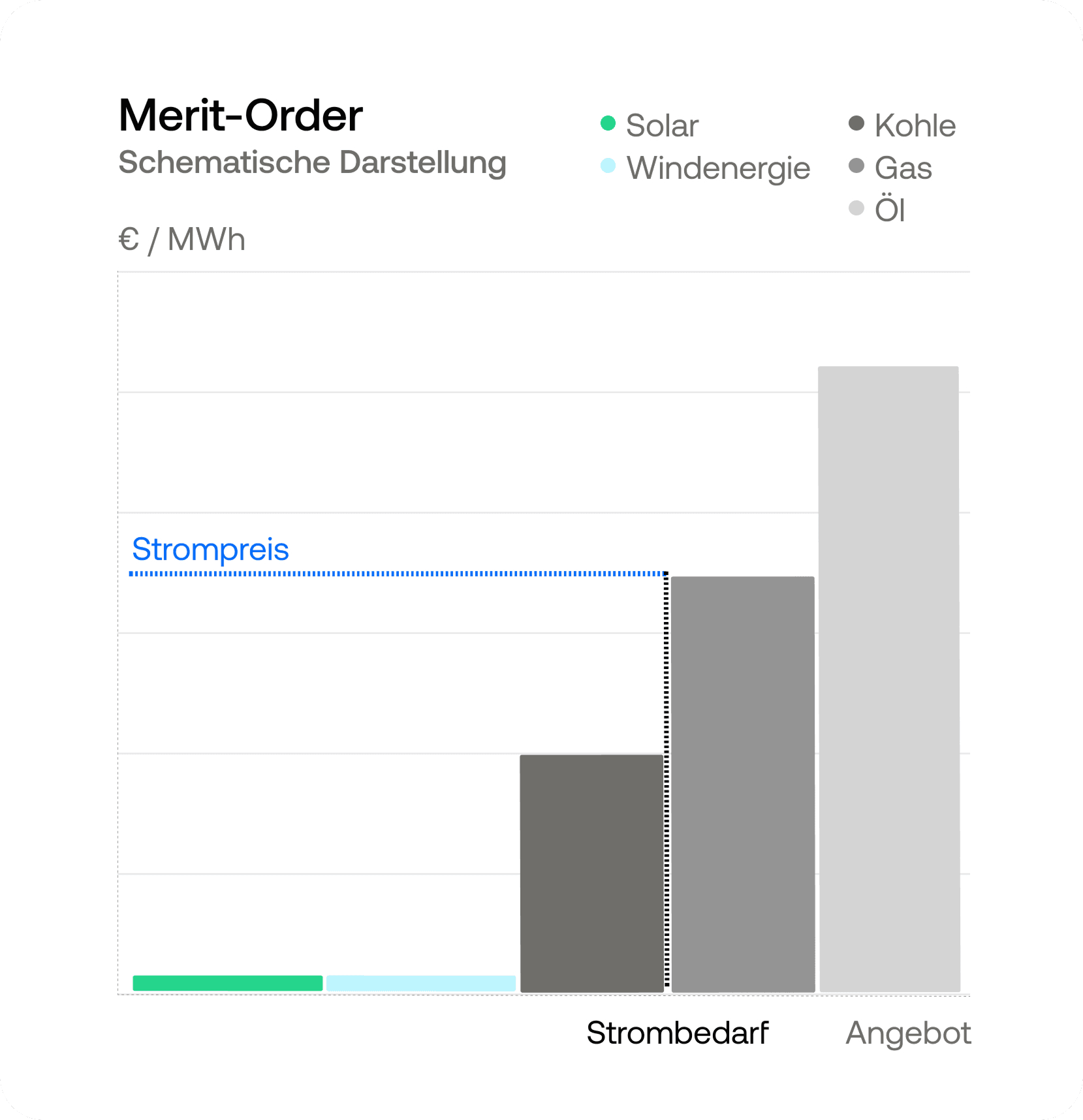
Graph demonstrating the merit-order principle [4]
Key takeaway for medium-sized businesses: A fixed price alone is no longer enough
This structural change will remain in 2026 and beyond. For medium-sized companies, this means: energy does not become cost-effective simply through "a good fixed price." The key is flexible tariffs and active management.
Those who can react to short-term price signals use favorable hours behaviorally. This reduces dependence on expensive times. Instead of paying for volatility via risk premiums in the fixed price, market opportunities are utilized.
This requires transparency over load and prices. With the energy management platform from trawa, you can continuously adjust procurement, take advantage of favorable windows, and save up to 30% in costs.
Learn here how you can benefit from flexible tariffs and set up your procurement mix appropriately for 2026: From fixed price to flexibility: This is what the modern procurement mix in 2026 looks like
How does structured procurement work?
At its core, structured procurement is about not fixing electricity prices all at once, but rather distributing purchasing and risk better.
Fixed price: simple, but often not flexible enough
A large proportion of medium-sized businesses have been procuring their energy via fixed prices for years. This means: the price is determined at contract signature and applies for the entire term.
However, energy prices are difficult to predict, especially in the long term. If market levels fall later, companies no longer benefit from it.
Why fixed prices are often above market levels
In order for fixed prices to be profitable for suppliers, they build in risk premiums. They hedge against rising energy prices. Therefore, the price is often above the market level, similar to an insurance premium.
An example: In a three-year full-supply contract with a fixed price, the price is often about 10% to 20%[4] higher than that of structured procurement, depending on the load profile and volume. [5]
Structured procurement: combining security and flexibility
An alternative is the combination of fixed and variable procurement shares. The goal is a good balance between price security and flexibility.
In the so-called structured portfolio model, electricity is not bought all at once. Instead, purchasing is staggered: at different times and across different products and delivery periods.
How the portfolio model works in practice
Staggered buying creates a mix of long-term hedging and the exploitation of short-term market opportunities. The staggering over time distributes the risk.
This balance is achieved through targeted over-coverage, for example with direct procurement from wind and solar parks (Power Purchase Agreements, PPA).
Companies can actively adapt their purchasing strategy to market developments: when prices are low, larger quantities are secured on a long-term basis, and when prices are high, procurement is more short-term.
Electricity is therefore not procured on a single deadline, but in several partial quantities at different times, comparable to an ETF savings plan for electricity.
The 3 main benefits of structured procurement
Reduce timing risk: An unfavorable point in time does not determine the entire price.
Smooth prices: Multiple buying points typically lead to a more stable average price.
Better control: If the market and forecasts change, the purchase of the next tranches can be flexibly adjusted.
Implementation: Portfolio management without an in-house energy team
Portfolio management is the most complex and flexible form of electricity procurement. It can combine the advantages of futures market, spot market, and PPAs.
In practice, many companies implement a structured portfolio with specialized service providers like trawa. These bundle structuring, risk logic, and transparency without requiring companies to build up their own energy team.
For which companies is structured procurement worthwhile?
In principle, this is worthwhile for companies with an annual consumption starting from approximately 2 GWh upwards. Below this, transaction costs are often too high in relation to the savings potential.
But smaller businesses too can get access to structured models through buying groups or specialized service providers.
Example calculation: What structured procurement can change at 5 GWh
An industrial company with 5 GWh annual consumption and a fixed price of 12 ct/kWh pays 600,000 euros per year for electricity.
With structured procurement utilizing 70 percent futures market and 30 percent spot share, the same company would have paid on average between 5 and 12 percent [4] less during the period 2023 to 2025, depending on the timing of the coverage. [5]
For 600,000 euros in basic costs, this corresponds to savings of 30,000 to 72,000 euros per year.
How can companies reduce electricity costs through flexibility?
Volatility is no longer a marginal phenomenon, it is the new normal. And that is exactly why flexibility will become a real economic lever for many medium-sized companies in 2026.
Battery storage: 4 concrete use cases in operation
Modern battery storage systems can be flexibly integrated into existing energy systems. They contribute to optimizing load profiles in a targeted manner:
Shifting electricity consumption: Battery storage systems enable targeted electricity purchasing during low-price phases and the use of stored energy during high-price times. This is a direct economic advantage given volatile exchange prices.
Capping peak loads: By deliberately discharging the storage system during peak load times, expensive capacity charges in network fees can be avoided.
Optimizing self-consumption: Excess solar power is stored and used later. For companies, direct self-consumption is often more worthwhile than feeding it into the grid.
Generating additional revenues: Battery storage systems enable additional revenues, for example via intraday trading. Companies can buy electricity cheaply, store it, and release it later at higher prices.
Why battery storage has become economically more attractive
The investment costs for battery storage systems have significantly decreased in recent years. In the meantime, they are at a stable low level.
Reasons include technological progress, growing production volumes, and economies of scale from the electromobility sector. As a result, storage solutions are today also economically attractive for medium-sized enterprises.
Read more about when battery storage makes economic sense and what savings and revenue potentials it offers in our article Battery storage for companies – Reduce electricity costs by 15%.
Practical example: Utilizing refrigeration flexibility without risking production
A medium-sized food producer with large cold storage facilities started working with trawa in 2024. Its cooling systems are pre-cooled during hours with negative electricity prices. During expensive hours, cooling is throttled.
Product quality remained unchanged as a result, but electricity costs dropped by 8%. This was not a miracle and required no million-dollar investment. It was intelligent control based on market data.
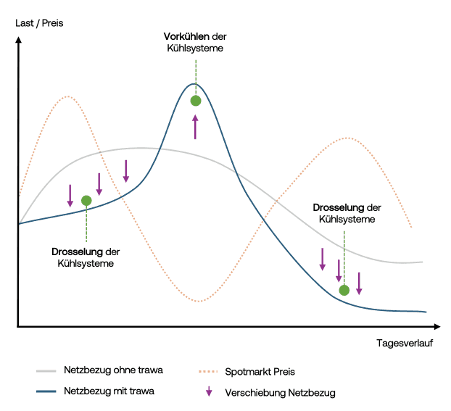
Schematic load distribution of a company with cooling flexibility [4]
Why data-driven decisions are becoming more important in energy management
The more volatile the market, the more crucial a clear decision logic becomes. In the past, it was often enough to: compare offers, fix a price, and check off the topic for the duration of the contract term. In 2026, this does not automatically lead to good results.
Because during strong fluctuations, what is crucial is not just whether you buy, but also how and when. Companies that establish their procurement on a data-driven basis gain one thing above all: more robust decisions.
What "data-driven procurement" means in practice
Using scenarios: As a "what-if" calculation, not as a prediction. Those who calculate through several plausible scenarios understand their risk profile better and make more targeted procurement decisions.
Establishing continuous market monitoring as a process: Structured procurement is an ongoing process. Regular updates help to plan hedges sensibly and justify adjustments.
Using tools beyond Excel: With multiple products and purchasing points, effort and errors increase. Energy management platforms like the one from trawa keep the complexity manageable without requiring an in-house energy team.
Determine savings potentials based on your load profile now.
FAQ on Energy Procurement 2026
What does "structured procurement" mean?
Electricity is not purchased all at once on a target date, but is rather staggered over different times, products, and terms. In this way, companies combine hedging with the utilization of short-term market opportunities.
From what level of consumption is structured procurement worthwhile?
As a rough rule of thumb, an annual consumption starting from about 2 GWh applies. Below this level, transaction costs can be too high in relation to the savings potential, depending on the model and implementation.
How can companies benefit from negative electricity prices?
In times of very low or negative prices, it is worthwhile to shift consumption to these hours or to store electricity temporarily. This only works if processes or storage systems can be flexibly controlled.
What role do battery storage systems play in reducing electricity costs?
Battery storage systems absorb electricity in cheap times and release it in expensive times. In addition, they help to reduce peak loads and increase self-consumption of solar power.
Conclusion: Energy management must be approached strategically in 2026
The market remains demanding, and that is exactly where the opportunity lies. Volatility has become the new normal. This increases the requirements for purchasing and energy management.
Companies cannot wait out this development, but they can decide to react to it professionally.
New opportunities for medium-sized businesses
The good news: what was previously only possible for large corporations is today also accessible to medium-sized businesses: structured procurement, flexibility (e.g. controllable loads and storage), and data-driven energy management.
Those who use these mechanisms do not just optimize the price. Above all, controlling energy costs becomes more stable and predictable.
The essentials of energy procurement in 2026
Fixed price alone is no longer enough, the handling of volatility is crucial.
Structured procurement reduces timing risks through staggered hedging.
Flexibility helps (e.g. storage, controllable loads) to avoid expensive hours.
Data improves decisions through scenarios, market monitoring, and appropriate tools.
Implementation counts: purchasing, consumption, and control must fit together in daily operations.
Next steps: Check your starting position and identify savings potentials
In the coming years, companies that actively manage their energy procurement with clear processes, good data, and established routines will prevail.
If you want to know which structure suits your load profile and where concrete potentials lie, start with a short, non-binding audit of your current procurement.
trawa supports you in the implementation and bundles structured procurement, flexibility marketing, and energy management into one solution.
The success story of textile producer SETEX shows what this looks like in practice.
Arrange a non-binding conversation with our experts:
Sources:
[1] BDEW: BDEW electricity price analysis (Data & graphics, 15.04.2026). https://www.bdew.de/service/daten-und-grafiken/bdew-strompreisanalyse/
[2] Fraunhofer ISE: Public electricity generation 2025: wind and solar as dual leaders for the first time (Press release, January 1, 2026). https://www.ise.fraunhofer.de/de/presse-und-medien/presseinformationen/2026/oeffentliche-stromerzeugung-2025-wind-und-solar-erstmals-als-doppelspitze.html
[3] EPEX Spot SE, Market Data Intraday Auctions Germany/Luxembourg, 2022 to 2025. Own evaluation of price ranges. https://www.ffe.de/veroeffentlichungen/deutsche-strompreise-an-der-boerse-epex-spot-im-jahr-2025/
[4] trawa
[5] BDEW: Facts and arguments – Energy procurement models and their effect on end-customer supply (Berlin, March 14, 2023). https://www.bdew.de/media/documents/Awh_20230314_Fakten_und_Argumente_Energiepreise_B%C3%B6rse_Endkundenmarkt_GySyvYK.pdf
Electricity purchasing