Electricity purchasing
From Fixed Price to Flexibility: This is What the Modern Procurement Mix in 2026 Looks Like

Written by:
Anne Fischer
Anyone talking to decision-makers in medium-sized businesses today about energy procurement often hears the same reflex: "We want a good fixed price – preferably for several years."
The desire is understandable. Fixed prices stand for predictability, for peace of mind in operations, for control. But: in 2026 they also stand for risk premiums that companies pay without realizing it.
The logic with which medium-sized companies successfully purchased energy for years no longer works that way. The market has changed fundamentally: in structure, volatility, and the opportunities it offers.
Those who ignore this will pay. Those who understand it can actively use the changes to their benefit.
This article explains why classic fixed-price logic is reaching its limits, what a modern procurement mix actually means, and how medium-sized enterprises in 2026 can sensibly combine predictability and market opportunities – without trading complexity.
Fixed prices alone no longer protect against risk – they merely shift it
A fixed price feels like security. In practice, however, it is often an insurance – and insurances are rarely free.
Suppliers offering a three-year fixed price today price in the market risk. The greater the uncertainty, the more expensive the hedging. Particularly in times of high uncertainty, such as the energy crisis of 2022 and the Middle East conflict in 2026, risk premiums defined the price.
In our webinar on contextualizing the Middle East conflict and its impact on electricity prices, we examine this in more detail. You can access the mentioned free webinar here.
The key takeaway is: anyone who signs a one-time fixed price contract in 2026 pays this risk premium – and often completely unconsciously.
Why procurement logic has changed and one-off fixed pricing has become so unappealing
For a long time, the fixed price was the most rational response in energy supply to a sluggish, relatively stable electricity market.
Until around 2010, medium-sized businesses had little reason to question this logic: price fluctuations were moderate, the market structure was straightforward, and suppliers could offer long-term fixed prices without excessive risk markups.
This has fundamentally changed.
The average industrial electricity price in Germany was around 12 to 14 cents per kilowatt-hour in 2010. In 2022, it temporarily exceeded 40 cents.
By comparison, looking at 2024: on the spot market, the price during cheap hours was under 5 cents – and during expensive hours once again well over 20 cents.
What has changed is not just the price level. It is the spread. One reason for this is the massive expansion of renewable energies.
Fixed price 2010 vs. 2025: The new limits of the model
The world of 2010: stable, straightforward, predictable
Electricity generation in Germany in 2010 was still heavily dominated by conventional power plants. The share of renewable energies in gross electricity consumption was around 17 percent.
Pricing followed a relative logic: fuel costs plus markups, few surprises, narrow daily bandwidths. Under these conditions, it was possible for suppliers to offer long-term prices without pricing in high risk markups.
For companies, this meant: a fixed price actually delivered what it promised – cheap hedging at acceptable conditions.
The world of 2025: volatile, complex, full of opportunities
In 2024, the share of renewable energies in gross electricity consumption exceeded 55 percent for the first time.
This fundamentally changes the price structure. On sunny and windy hours, plants with marginal costs close to zero feed huge amounts of electricity into the grid, causing the spot price to fall – sometimes into negative territory. The reason for this is the merit order principle.
The impact of the merit order principle on electricity prices
The electricity price is determined hourly according to a simple principle: the most expensive power plant still needed in that hour sets the price. If little wind and sun are available, gas or coal-fired power plants often have to step in, and the price rises. When plenty of wind and sun are available, these more expensive power plants are no longer needed, cheaper producers determine the price, and it can become very low or even negative.
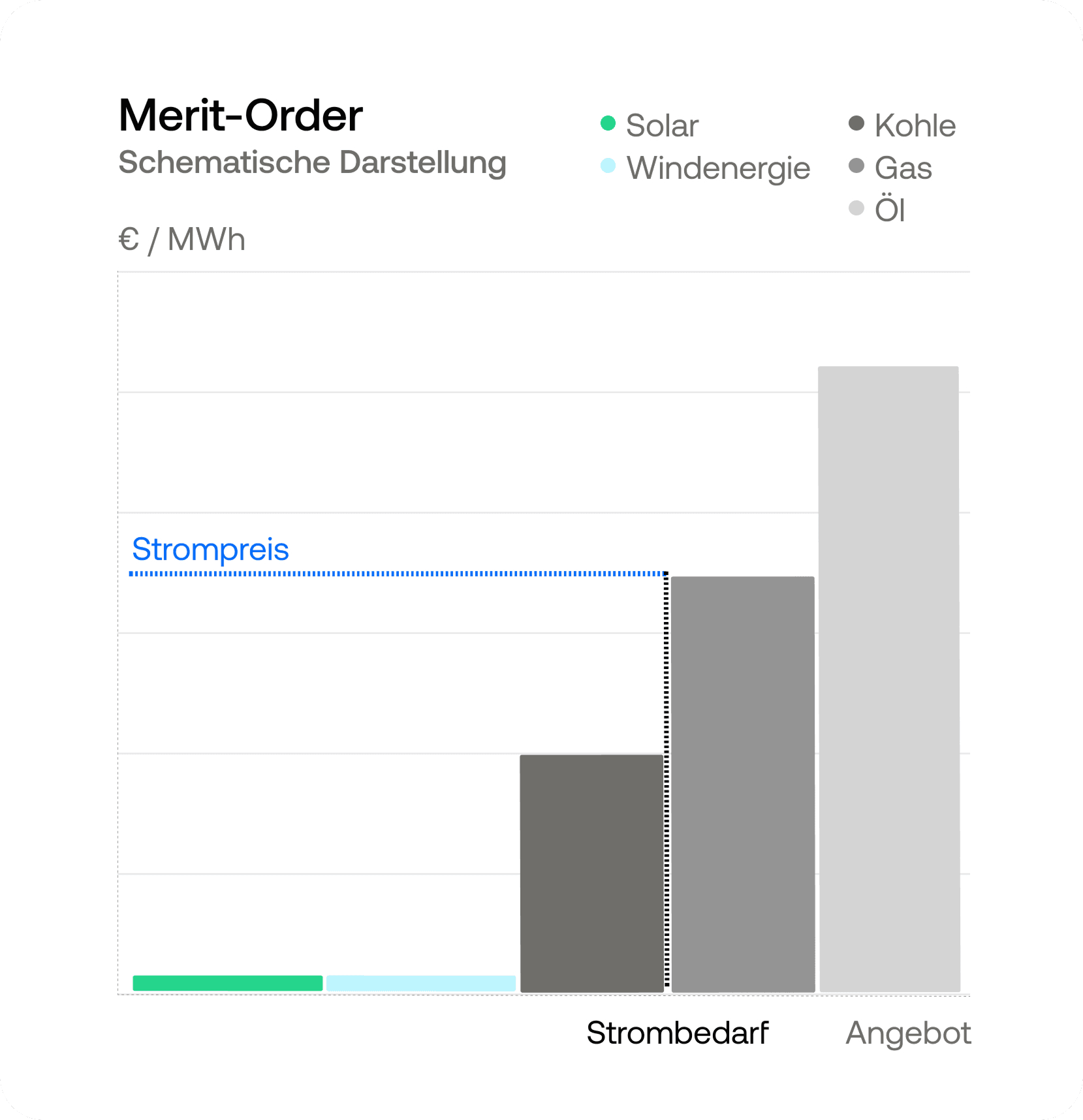
Infographic on the Merit Order Principle | Source: trawa
The number of hours with negative electricity prices increased from around 146 hours in 2021 to over 450 hours in 2024.
The result of this: the spread between cheap and expensive hours is continuously increasing.
Intraday volatility on the EPEX Spot has increased significantly over the past three years. Price fluctuations of over €200/MWh within a single day are no longer an exception.
What the increased volatility means for fixed prices
Suppliers offering a multi-year fixed price in 2025 or 2026 must factor in this uncertainty. Typically, markups for full-supply contracts with fixed prices today are 10 to 20% higher than structured procurement – depending on the term, load profile, and market situation.
Anyone paying this markup is buying a kind of insurance without knowing what it actually costs.
On top of this is another risk: signing a long fixed-price contract at an unfavorable time locks in high costs for years. The difference between the best and worst quarters for an annual contract on the futures market was up to 40 percent between 2022 and 2025.
What "flexibility" in procurement means – and what it does not
For many companies, flexibility sounds like risk and trading – the exact opposite of predictability. This is a misunderstanding, because flexibility is not speculation.
Speculation vs. structural controllability
Speculation means consciously betting on a market direction with the goal of profiting from short-term price movements. That is not what structured energy procurement is about: Flexibility is structural controllability.
In structured procurement, energy demand is not purchased all at once at a single point in time, but is spread over several points in time, instruments, and terms – in such a way that market opportunities can be utilized without exposing the company to uncontrolled risk. These purchase points are not chosen at random, but within pre-established risk-minimization limits in clearly defined time windows.
As a result, with structured procurement, the customer bears lower risk over a long period than with a one-off fixed rate.
We look closer at the mechanism behind establishing these limits in our webinar. Click here to access the recording of this free informative material.
Alternatively, you are welcome to book a non-binding consultation with us to evaluate how much savings potential you can achieve through structured procurement.
Feel free to schedule an appointment here.
An overview of the main procurement models
Depending on how much predictability you need and how much market opportunity you want to leverage, these four models are the most relevant in practice:
Fixed price (Full supply): The supplier bears the entire price risk. The company pays a fixed price regardless of development on the market. Simple and predictable, but with a priced-in risk premium.
Spot procurement: Electricity is procured on short notice, often daily, on the spot market. Maximum market opportunities, but also maximum price volatility. Only suitable for companies that can closely coordinate consumption and procurement.
Tranche model: Total demand is split into several portions and purchased at different times on the futures market. This significantly reduces the risk of entering the market at an unfavorable time.
Mixed model (structured procurement mix): Combines futures market portions (safety), spot portions (opportunities), and if applicable, self-generation. This approach is the most financially sensible solution for most medium-sized companies in 2026.
The modern procurement mix 2026: An overview of the building blocks
A modern procurement mix is not a rigid model. It is a structured combination of three building blocks, which are weighted differently depending on the company, consumption profile, and risk tolerance: a base hedge, market-based portions, and the utilization of self-generation systems and storage.
1) Base hedge: Predictability as the foundation
The first building block of the procurement mix remains essentially hedging. This portion is purchased on the futures market and typically represents 60 to 80 percent of yearly demand. It is usually procured across multiple tranches.
Why tranches instead of a single transaction?
Because the best purchase time cannot be guaranteed or predicted. By spreading the purchase over multiple tranches, the risk of having to lock in a price at an expensive time is avoided. At the same time, the opportunity to secure an even cheaper price at a later date remains accessible.
Buying the demand spread over four to eight tranches – quarterly, over 2-3 years – averages out the entry price and significantly reduces timing risk.
Futures contracts usually run one to three years ahead. Through this long-term distribution, structured procurement becomes predictable security. And it creates another advantage: in times of crisis or unfavorable market situations, individual tranches can be flexibly skipped to avoid peak prices.
"I am glad that we have already secured our electricity demand for 2026. With current wild prices, I can now simply lean back and relax!"
– customer of trawa.
For 2026, this means: companies procuring now can lock in portions of their demand at current market prices while keeping room for maneuver for later tranches.
2) Market-based portions: Systematically seizing opportunities
The second building block is a spot market portion. Typically, this accounts for 10 to 30% of total demand. The spot portions are generally procured on short notice, often day-ahead (the day before) or intraday (within a single day).
During periods with high shares of renewable energies in the power mix, spot prices are regularly significantly cheaper than futures market prices.
Those who manage this share smartly – such as through automated rules or external control – can profit from these market phases.
An example: An industrial company with 5 GWh annual consumption and a fixed price of 12 cents per kilowatt-hour pays 600,000 euros per year.
With structured procurement consisting of a 70% futures portion and a 30% spot portion, the same company would have paid an average of 5 to 12% less during the period of 2023 to 2025, depending on the timing of the tranches.
At €600,000 base costs, this corresponds to savings of €30,000 to €72,000 annually.
3) Self-generation and storage: Complementing, not replacing
The third building block is optional but is gaining increasing relevance. Anyone operating a photovoltaic system can increase their self-consumption share through intelligent control and shift remaining electricity purchases into favorable market phases.
Battery storage also makes it possible to store cheaply generated or purchased electricity and use it during phases of higher market prices.
Additionally, customers with battery storage can actively participate in dynamic electricity purchasing and arbitrage trading, thereby further increasing the profitability of their storage.
Through the optimized use of its 1,050 kWh storage system, trawa customer Wein- und Sektkellerei Jakob Gerhardt achieved a 23% optimization of electricity costs within 6 months. The focus for them was on increasing PV self-consumption, capping load peaks, as well as dynamic electricity purchasing and arbitrage trading.
Furthermore, investment costs for lithium-ion storage fell by around 40% between 2020 and 2025. This has once again significantly improved the payback period and cost-effectiveness of storage systems.
However, it is important to add here:
Self-generation does not replace a well-thought-out procurement strategy. It is a building block that should be sensibly integrated – but must not be overestimated. A typical self-sufficiency share through rooftop PV for manufacturing companies lies between 10 and 25 percent of total demand, depending on the roof area, consumption profile, and shift operation.
Which mix is suitable for whom – and for whom it is not
There is no single correct model. Which procurement mix is sensible depends on three factors: consumption volume, load profile, and organizational capacity.
Consumption volume
Starting from an annual consumption of approximately 2 GWh, structured procurement with tranche models is financially lucrative. Below that, transaction costs and administrative effort are often too high relative to savings potential, although buying groups or specialized service providers can offer access here as well.
From 5 GWh upwards, spot portions and more active portfolio management become attractive.
From 10 GWh upwards, a differentiated procurement strategy utilizing multiple instruments is not just sensible, but economically necessary.
Load profile
Companies with stable, predictable load profiles can plan their demand more precisely, which facilitates procurement and reduces balancing energy risks. Companies with heavily fluctuating or seasonal load profiles must adjust their strategy accordingly and budget in buffers.
Particularly interesting here is flexibility potential: those who can shift energy-intensive processes, such as cooling systems, compressed air, heat pumps, and batch production processes in time can actively profit from price fluctuations.
Organizational capacity
Structured procurement requires processes and responsibilities. Anyone who does not have someone internally to regularly check market data and make procurement decisions should outsource this part – but should not fall back on a basic fixed price. The complexity can be delegated. The decision of how much risk the company carries should be made consciously.
trawa handles exactly this part: from market monitoring and tranche control to decision support – so that you keep control without having to manage the complexity yourself. Click here and schedule a non-binding consultation.
Typical configurations by company size
2 to 5 GWh: 80 % futures market tranche model, 20 % Day-Ahead spot, no or simple flexibility measures
5 to 15 GWh: 65 to 70 % futures market in 4 to 6 tranches, 20 to 25 % spot, self-generation and initial flexibility measures if applicable
Over 15 GWh: Fully structured portfolio with futures market, spot, flexibility marketing, and active monitoring
The 5 biggest mistakes when transitioning from fixed price to flexibility
More flexibility in procurement sounds right – and it is. But the transition is prone to errors. Anyone who knows the most common pitfalls avoids unnecessary costs.
Mistake 1: Transitioning too quickly without clear processes.
Structured procurement requires defined responsibilities and reliable database systems. Anyone who cancels their full-supply agreement and immediately starts buying on the spot market without anyone internally tracking market data or making purchasing decisions risks high balancing energy costs and unplanned price risks.
Mistake 2: Inflated savings expectations.
Structured procurement saves considerably compared to poor fixed prices, but is no guarantee for the absolute lowest rate. The goal is not perfection, but systematically making better decisions than with purely fixed prices, thereby achieving a better long-term average.
Mistake 3: Only comparing prices, not running scenarios.
What happens in a mild winter, an LNG (liquefied natural gas) bottleneck, or faster expansion of renewables? Those who run multiple scenarios make structurally better decisions. The most expensive decision in energy procurement is the one made out of habit.
Mistake 4: Dependency on single individuals.
If knowledge of energy purchasing rests with a single person, it is gone during the next staff rotation. Structured procurement needs documented processes, not just individual expertise.
Mistake 5: Timing as the only lever.
Anyone who believes it is purely about buying at the right time has only partially understood the concept. Tranche distribution, risk distribution across instruments, and process continuity are often more important levers.
What medium-sized businesses should concretely do now
The good news: anyone starting to review their procurement logic today is on time. The bad news: those who wait until the next contract renewal throw away room for maneuver.
Five questions help to honestly assess your own status quo:
How much risk premium is hidden in the current contract? Full supply, structured, or mixed – and what does that actually cost?
What is our flexibility potential? Are there energy-intensive processes that could be shifted in time? Do we have PV or storage?
Are we running scenarios or just comparing prices? Which procurement structure can withstand a mild winter, a gas bottleneck, or faster renewables expansion?
Are our procurement processes documented? Who decides when, who monitors the market, who reports to management – or is all this handled by a single individual?
Have we integrated self-generation and storage into the overall strategy? Or does the PV system still run disconnected alongside procurement?
Anyone who can answer these questions has the foundation for a sustainable procurement mix. Those who cannot, know where they should start.
The fixed price is not disappearing – but it is no longer enough on its own
The fixed price on its own is not the problem. It becomes a problem when it is the only answer to today's complex and volatile electricity market.
Those who want to be well-positioned in 2026 combine predictability with market opportunities: a secured base via structured futures market shares, a spot market share that profits from favorable market phases, and – where appropriate – self-generation and flexibility measures as complementary components.
No trading desks or speculation, but a systematic management of risks that are currently present in the market anyway – whether you actively manage them or not.
The difference between companies that view energy procurement as a yearly routine exercise and those who grasp it as a strategic function will in many cases be measurable in five- to six-figure amounts.
trawa as a partner: Delegating complexity, maintaining control
This is exactly where trawa steps in: we support medium-sized companies in setting up a structured procurement mix that creates predictability while making market opportunities usable – without you having to build an internal trading desk for this.
The complexity can be delegated. You make the decision on how much risk your company wants to carry consciously – with clear processes and transparency regarding the relevant levers. Click here and let us advise you dynamically.
Sources:
Historical Industrial Electricity Prices Germany (2010–today): https://www.stromauskunft.de/industriestrom/was-kostet-industriestrom/
Statista – Industrial Electricity Price Germany since 1995: https://de.statista.com/statistik/daten/studie/155964/umfrage/entwicklung-der-industriestrompreise-in-deutschland-seit-1995/
Electricity Price Development 2026 – Verivox: https://www.verivox.de/strom/strompreisentwicklung/
Destatis – Energy Price Development (Publication): https://www.destatis.de/DE/Themen/Wirtschaft/Preise/Publikationen/Energiepreise/energiepreisentwicklung-pdf-5619001.pdf
BDEW – Renewable Energies 2024: well over 55 % of gross electricity consumption: https://www.bdew.de/presse/presseinformationen/erneuerbare-energien-erreichen-neuen-hoechstwert-gut-55-prozent-des-stromverbrauchs-in-2024-gedeckt/
Fraunhofer ISE – Public Power Generation 2024: https://www.ise.fraunhofer.de/de/presse-und-medien/presseinformationen/2025/oeffentliche-stromerzeugung-2024-deutscher-strommix-so-sauber-wie-nie.html
Federal Environment Agency – Share of Renewables in Gross Electricity Consumption: https://www.umweltbundesamt.de/indikator-anteil-erneuerbare-am
FfE – German Electricity Prices at the EPEX Spot 2024 (459 hours negative): https://www.ffe.de/veroeffentlichungen/deutsche-strompreise-an-der-boerse-epex-spot-im-jahr-2024/
FfE – German Electricity Prices at the EPEX Spot 2025: https://www.ffe.de/veroeffentlichungen/deutsche-strompreise-an-der-boerse-epex-spot-im-jahr-2025/
Statista – Negative Electricity Prices: Number of Hours in Germany: https://de.statista.com/statistik/daten/studie/618751/umfrage/anzahl-der-stunden-mit-negativen-strompreisen-in-deutschland/
EPEX SPOT – Q&A Negative Prices (PDF): https://www.epexspot.com/sites/default/files/download_center_files/Q&A Negative Preise.pdf
Fraunhofer ISE – Power Generation 2024 (PDF): https://www.ise.fraunhofer.de/content/dam/ise/de/documents/presseinformationen/2025/Stromerzeugung_2024.pdf
Tagesspiegel Background – Waiting for Reiche's Gas Storage Concept: https://background.tagesspiegel.de/energie-und-klima/briefing/warten-auf-reiches-gasspeicherkonzept
ZfK – Gas Storage Association Sees Filling at Risk: https://www.zfk.de/unternehmen/beschaffung/steigende-gaspreise-gefaehrden-rechtzeitige-aufuellung-der-speicher-zum-naechsten-winter
INES – Refilling as a Central Challenge: https://energien-speichern.de/ines-gas-szenarien-gasversorgung-fuer-restwinter-gesichert-wiederbefuellung-wird-zur-zentralen-herausforderung/
FAZ – Von der Leyen: How the EU Wants to Lower Electricity Prices: https://www.faz.net/aktuell/wirtschaft/mehr-wirtschaft/von-der-leyen-so-will-die-eu-strompreise-senken-accg-200639747.html
EU Commission – Von der Leyen on Power Supply: https://germany.representation.ec.europa.eu/news/kommissionsprasidentin-von-der-leyen-zu-stromversorgung-kernenergie-und-erneuerbare-energien-spielen-2026-03-10_de
Spiegel – Electricity Market Reform & Cheaper Energy: https://www.spiegel.de/wirtschaft/unternehmen/strommarkt-reform-ursula-von-der-leyen-stellt-verbrauchern-billigere-energie-in-aussicht-a-fe8bdef9-6435-44fb-abc3-972c847b8fa7
Electricity purchasing