Electricity purchasing
Industrial electricity comparison – uniting savings potential & sustainability

Written by:
Julia Buchterkirchen

What is industrial electricity?
Industrial electricity refers to electricity supplies used by large or very large consumers, such as industrial enterprises, for their production processes, for example in industrial facilities, machinery, or factories. Their power requirements are generally higher than those of private households or commercial businesses.
Therefore, there are corresponding industrial electricity tariffs for large consumers that are tailored to the specific needs of energy-intensive companies. For example, electricity can be purchased at cheaper rates at certain times. Through appropriate load management, companies can optimize their electricity purchasing and reduce peak consumption.
Industrial electricity – why comparing is important
For companies, especially in the manufacturing sector, electricity consumption is a key cost factor. Industrial electricity contracts vary widely in price, term, and included services.
In order to ensure both cost-effectiveness and to meet sustainability goals, it is worth comparing providers in detail. In addition, the market now offers numerous options to cover electricity consumption directly from renewable energy sources through innovative solutions such as Power Purchase Agreements (PPAs).
Important criteria when choosing an electricity provider
When selecting the right industrial electricity tariff, several factors play a role:
- Price structure: What fixed and variable costs are there? Is there an opportunity to benefit from price fluctuations on the exchange?
- Contract term: Long terms offer planning security, while shorter contracts allow for flexibility.
- Sustainability goals: Green energy tariffs that improve the CO₂ footprint and contribute to corporate sustainability goals.
- Flexibility: How well does the tariff match the individual consumption profiles of the company? Are there options for load shifting or flexibility in purchasing?
- Security of supply: Especially for energy-intensive businesses, the constant availability of electricity is crucial.
Advantages of a Power Purchase Agreement (PPA)
More and more companies are opting for PPAs to benefit from renewable energy while also leveraging financial advantages. Here are the key benefits:
- Price stability: Long-term contracts ensure stable electricity prices, independent of market fluctuations.
- Transparency and predictability: Companies have clear calculation bases, as the electricity price is fixed for years.
- Image boost: Green electricity strengthens the sustainable image and can be highlighted in communication to customers and stakeholders.
- Sustainability: Purchasing electricity from renewable energy sources improves the company's CO₂ footprint and supports the achievement of ESG goals (Environmental, Social and Corporate Governance criteria of the United Nations).
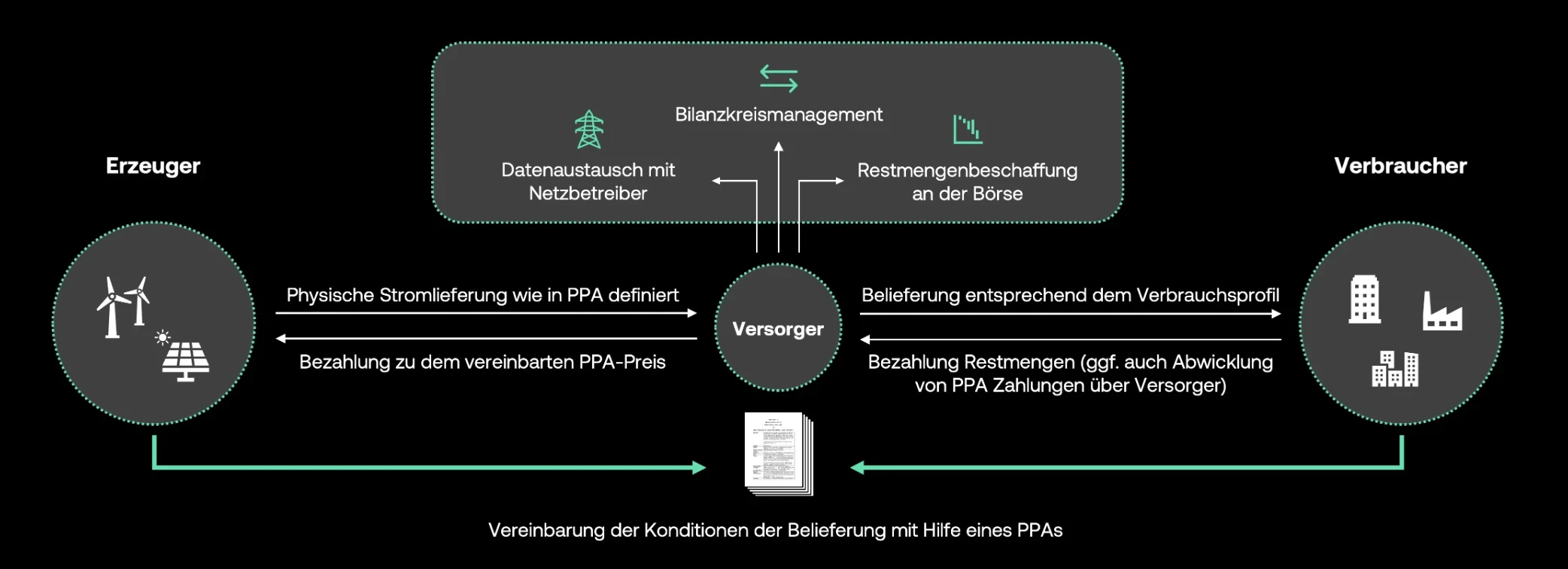
A PPA can be concluded on a bilateral level, but requires an electricity supplier in the middle to handle transaction processing. As a trawa customer, you receive everything from a single source.
What does the ESG guideline stand for?
The ESG (Environmental, Social, and Governance) guideline stands for criteria that oblige companies to integrate environmental, social, and governance aspects into their business models. It aims to ensure that companies operate more sustainably by reducing their environmental impact, taking social responsibility, and promoting transparent corporate governance.
This guideline is primarily aimed at investors to support a more sustainable investment policy, and it helps companies manage risks in the areas of environment, society, and governance.
FAQ on Industrial Electricity Comparison
Who benefits from the industrial electricity price?
Mainly energy-intensive companies benefit from industrial electricity tariffs. These include manufacturing enterprises, processing industries, the chemical and metal industries, as well as large logistics companies. Through special contracts and models like Power Purchase Agreements (PPAs), these companies can not only lower their energy costs but also reduce their CO₂ emissions by switching to green electricity.
How is the industrial electricity price calculated?
The price for industrial electricity is composed of several factors:
- Energy price: This is traded on the electricity exchange and can fluctuate significantly depending on market conditions.
- Grid fees: These fees are charged for the use of the electricity grid.
- Taxes and levies: These include the EEG levy, electricity tax, and concession fees.
- Other fees: Depending on the region and consumption profile, additional costs may arise, such as for metering and billing.
Compare electricity yourself or have it automatically optimized?
Companies have the option to compare their electricity consumption themselves and select contracts manually. However, this requires time and expertise. Alternatively, service providers such as energy managers or software solutions offer the possibility to automatically optimize electricity purchasing.
These systems continuously analyze the market, identify savings potential, and manage purchasing based on current prices and consumption patterns.
The trawa Green Electricity Solution
We at trawa offer commercial customers such a cost-effective green electricity solution. With our solution, savings potentials of up to 30 percent can be realized through optimal electricity procurement and flexible consumption.
To achieve this, we use state-of-the-art technology and combine the flexibility of exchange trading with long-term power purchase agreements. We conclude such Power Purchase Agreements, or PPAs, with operators of wind and solar parks. With the help of artificial intelligence and cloud solutions, we align your electricity purchasing and your energy management with each other and optimize them.
Every company, regardless of its size, gains access to favorable green electricity tariffs through our trawa green electricity solution and can benefit from it. At the same time, our energy management solution supports you in resource-saving energy consumption.
Electricity purchasing