Updates
Grid fee reform: these changes are coming for industrial companies

Written by:
Anne Fischer

The way grid fees are calculated in Germany is about to undergo a fundamental change. The current Electricity Grid Fee Regulation (StromNEV) will expire on December 31, 2028. [1]
With the grid fee reform towards AgNes (Allgemeine Netzentgeltsystematik - General Grid Fee System), the Federal Network Agency (Bundesnetzagentur) has initiated a reform process that can have significant implications for industrial and commercial companies. [1] Anyone who understands the mechanisms early on can adapt their energy strategy in good time and also save money.
This document gives you a compact overview:
What is the grid fee reform and why is it necessary?
What has happened so far and when do changes take effect?
Which changes are currently being discussed?
Our expert team would also be happy to support you beyond this article, with a consulting offer on the appropriate options for action for your company.
Get a non-binding consultation now
What is the grid fee reform?
The grid fee reform describes the fundamental advancement of the system according to which electricity grid fees in Germany are determined and distributed among different grid users. At its core, the aim is to determine which players will contribute in what form to the costs of operating, maintaining, and expanding the electricity grids in the future.
The new system is named AgNes (General Grid Fee System) and will replace the previous Electricity Grid Fee Regulation (StromNEV) in 2029.
The aspects under consideration include:
Distribution of grid costs between stakeholder groups
Design of individual fee components
Temporal and regional differentiation of grid fees
Possible standardization of grid fees
Suitable fee regulations for storage systems
Why is the grid fee reform necessary?
High grid costs due to the energy transition
By 2045, expansion and replacement investments in the electricity grids are expected to cost over 600 billion euros.Increasing demands due to the decentralized energy transition
The expansion of renewable energies, decentralized feed-in, and rising electricity consumption from electromobility, heat pumps, and industrial electrification are fundamentally changing the demands on the electricity grids.One-sided cost distribution
To date, electricity consumers have borne the grid costs exclusively. In contrast, producers, feed-in operators, and storage systems pay no grid fees, even though they also use the grid and contribute to expansion costs.Lack of location incentives
The nationwide uniform bidding zone combined with locally fragmented grid fees offers almost no economic incentives for a grid-optimized choice of location or operation of facilities.Grid-beneficial behavior is not rewarded
The existing system favors constant consumption (e.g. baseload privilege) and penalizes flexibility – such as adjusting the load during surplus renewables or grid bottlenecks – through higher peak load fees.

Which changes are currently being discussed?
On May 27, 2026, the Federal Network Agency presented its first fully comprehensive concept for the new grid fee system starting in 2029. The formal consultation of the draft framework agreement is expected to begin in summer 2026 and should be completed by the end of 2026. [8]
The following reform elements reflect this current status, but have not yet been formally adopted.
The 6 reform elements at a glance
Below you will find the dynamic proposals – compactly summarized.
Grid fee components
Dynamic grid fees
Feed-in fees
Storage fees
Special grid fees for industry
Final-consumption-keyed cost allocation (Wälzung)
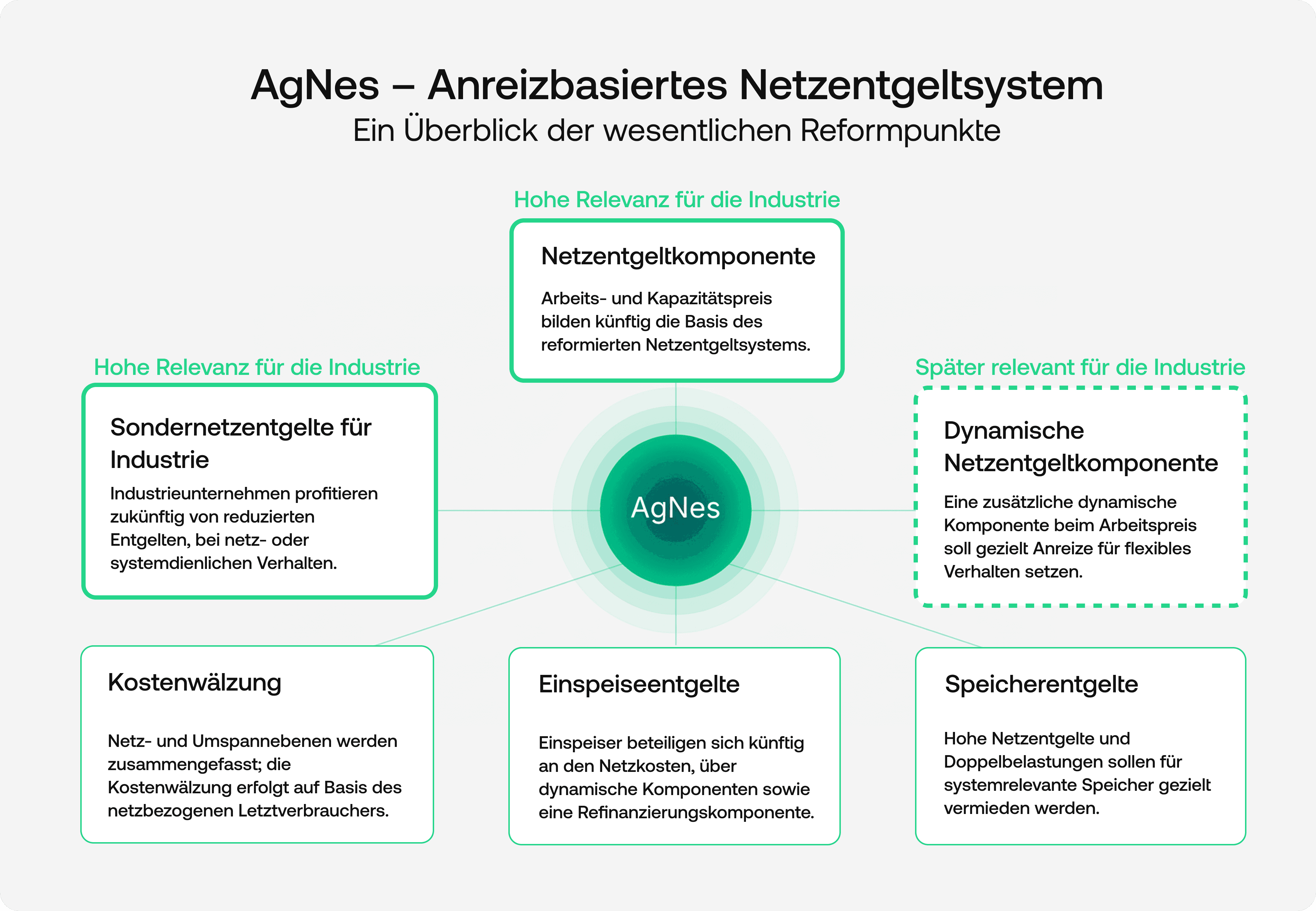
Source: Federal Network Agency / trawa analysis as of 27.05.2026
Grid fee components

Change from demand charge to capacity charge
In the future, a portion of the grid costs for customers with more than 100,000 kWh of annual consumption will no longer directly depend on the amount of electricity drawn, but rather on the provision of grid capacity. This is the so-called capacity charge.
Unlike today's demand charge (annual peak load), customers can freely choose their capacity on an annual basis.
This capacity price (€/kW/year) is due for the ordered capacity, supplemented by a two-stage commodity charge (Arbeitspreis): This is cheaper within the ordered capacity, and more expensive when exceeded.
Advantage of the capacity charge
Costs become more predictable and aligned with causation. Flexible electricity consumption is less discouraged than under the old demand charge, as exceedances are permitted.
Disadvantage of the capacity charge
Companies must forecast their capacity accurately. Booking too low leads to higher commodity charges when exceeded, and booking too high leads to unnecessary fixed costs.
Dynamic grid fees

The basic idea is that grid utilization becomes more expensive when grid capacity is scarce, and cheaper or even rewarded when there is free capacity or when an additional load yields system-beneficial behavior. Anyone who can flexibly consume or generate electricity will be rewarded for it in the future. [8]
The introduction is scheduled for 2030 at the earliest. The Federal Network Agency will not develop the concept until 2027 (including an impact analysis regarding feedback effects on the wholesale market and redispatch). The current schedule:
2030-33: At the highest grid levels and for storage systems with their own grid connection
2032–2035: Specific decision for feed-in operators
Not yet scheduled: In the medium voltage range, for feed-in operators, and finally for consumers
According to the Federal Network Agency, the implementation dates can still be adjusted. A final determination is announced for the end of 2026. [8]
Advantage of dynamic grid fees
If successfully implemented, bottlenecks could be reduced, grids utilized more efficiently, and the need for grid expansion decreased. Flexible consumers and storage systems can even generate revenue through bottleneck-relieving behavior.
Disadvantage of dynamic grid fees
The shift to dynamic pricing is associated with high technical and administrative challenges. Prices are determined daily on the previous day in 15-minute intervals and introduce additional price uncertainties beyond the energy price risk.
Feed-in fees

To date, grid costs have essentially been borne by consumers. In the future, feed-in operators could be involved through three instruments:
Dynamic grid fees (incentive function): bottleneck-dependent, variable in time & space. Introduction 2032 at the earliest, 2035 at the latest (see section Dynamic grid fees)
Capacity charges (refinancing function): based on contractually agreed grid connection capacity (4–7 €/kW/year, starting from 2029). No volume-based fees will be levied [8]
Grid connection contributions (Baukostenzuschüsse): one-time payments for new connections (regulatory framework from 2027)
The Federal Network Agency has clarified: volume-based grid fees for financing for feed-in operators are to be completely eliminated. A pure capacity price model applies. [8]
Advantage of feed-in fees
A broader, causation-based financing baseline with regionally fair cost distribution and potential for bottleneck relief.
Disadvantage of feed-in fees
Feed-in operators are expected to pass costs onto electricity prices (creating an intransparent burden for energy-intensive consumers), which threatens the profitability of existing plants and worsens the competitive position of German producers compared to foreign assets. Therefore, this is the most controversial element of the AgNes reform.
Grandfathering for feed-in operators: 20-year fee exemption for feed-in operators
The Federal Network Agency defined clear criteria for grandfathering in its comprehensive concept on May 27, 2026. Assets that meet both of the following requirements are exempt from the new capacity charges for 20 years from commissioning. [8]
Requirements
Commissioning of the asset by August 4, 2029
Final Investment Decision (FID) by the end of 2026
Both criteria must be cumulatively met.
The FID deadline at the end of 2026 is the real sticking point: anyone who makes the investment decision too late loses the 20-year protection – even if the asset goes into operation well before August 2029. For project developers and investors in solar parks, gas power plants, and electrolyzers, the rule is: establish clarity now, do not wait. [8]
Existing storage assets that are currently exempt from grid fees under § 118 para. 6 of the Energy Industry Act (EnWG) will continue to enjoy this protection under the new AgNes system.
Storage fees

Storage systems play a dual role, as they draw electricity from the grid and feed it back at a later time. Through this dual role, they contribute to flexibility, security of supply, and price dampening.
The current full grid fee exemption for storage systems is limited until August 4, 2029. After that, all storage systems (regardless of whether Stand-Alone or Co-Location) are fundamentally subject to the general grid fee system.
In the future, storage systems will pay a moderate capacity charge for grid financing. Volume-based charges will not be levied for storage systems. Netting of feed-in and feed-out volumes as a calculation basis is therefore no longer planned.
Home storage systems in low voltage remain completely exempt from fees.
Dynamic grid fees with incentive functions will be introduced for storage systems from 2030 at the earliest. The Federal Network Agency initially plans to develop a concept in 2027. [8]
Advantage of storage fees
Storage systems would contribute more appropriately to grid costs. At the same time, dynamic fees with an incentive function open up significant optimization and revenue opportunities under grid-friendly behavior.
Disadvantage of storage fees
Additional grid fees could impair business models and investment incentives for storage systems during the transition phase.
Special grid fees for industry

Atypical grid usage (§ 19 para. 2 sentence 1)
No permanent follow-up regulation is planned. A transitional extension for existing industrial customers with at least 10 GWh is under review.
Baseload (§ 19 para. 2 sentence 2–4)
Functional successor via a special industrial grid fee with flexibility requirements. Discounts remain possible at similar high levels (up to ~80 to 90%), but only with genuine system utility. A transition period until the end of 2031 is planned for existing customers.
Advantage of special grid fees for industry
Discounts are coupled to real system utility instead of rigid consumption behavior. This creates incentives for network-beneficial and system-beneficial behavior by industry.
Disadvantage of special grid fees for industry
Companies must be able to implement flexibility technically and organizationally; abolishing previous rules could create economic uncertainty for current beneficiaries. This is one of the largest current growth opportunities for trawa's flexibility division.
Final-consumption-keyed cost allocation (Wälzung)

Today, grid areas with high decentralized generation contribute disproportionously low shares to the costs of upstream grid levels, even though these costs barely decrease because of it. This favors tariff anomalies and false incentives in location choice.
The Federal Network Agency proposes to decouple cost allocation from the previous fee system and instead use grid-related final consumption as the key. This enables a more stable, regionally balanced cost allocation and complements the existing renewable energy surcharge compensation.
Concrete effect: General grid fees in high voltage will decrease by 20–80%, which particularly relieves industrial customers at this level.
Advantage of final-consumption-keyed cost allocation
Industrial customers at higher voltage levels benefit from significantly lower general grid fees. The previous disadvantage of having to pay proportionally for upstream grid levels that are not directly used is thus reduced.
Disadvantage of final-consumption-keyed cost allocation
Grid areas with previously low pass-down shares could bear higher cost shares; the transition requires data reporting from all grid operators.
Timeline: When are the changes coming?
The reform process takes place in steps and the exact timeline can still shift. However, the following milestones are emerging:
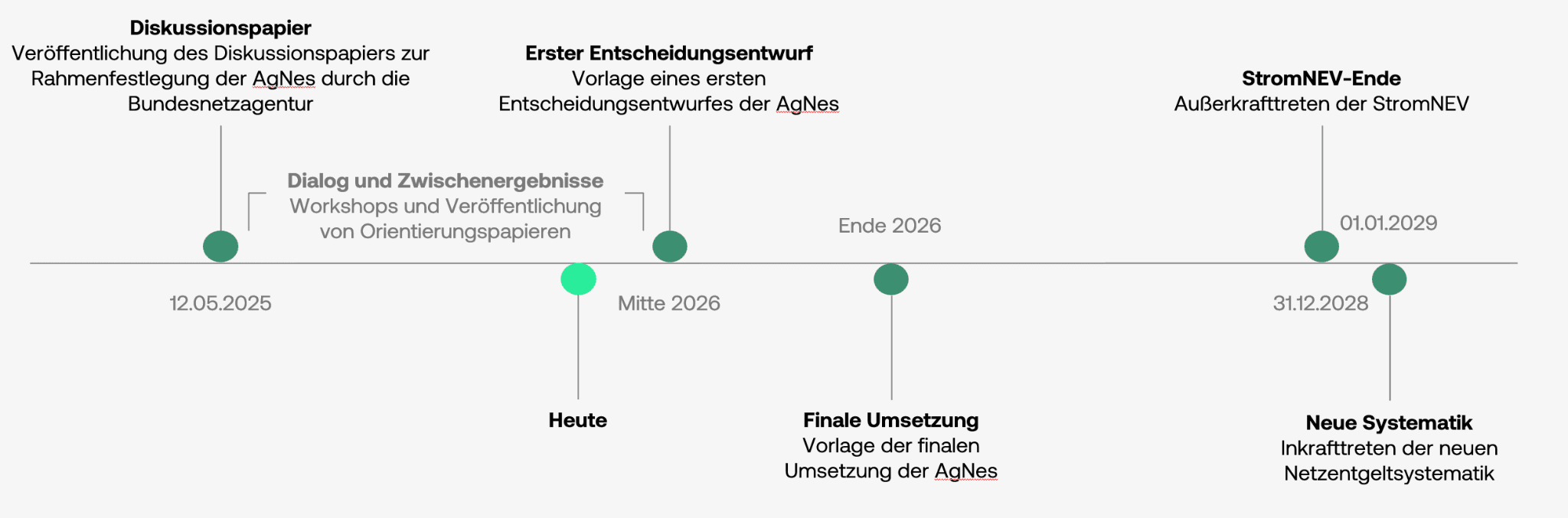
Source: trawa
Conclusion: This is what changes for industrial companies
The AgNes reform makes grid fees more complex, but also more manageable. Those who choose capacity intelligently, react to market and grid signals, and use storage systems effectively can lower costs and unlock new revenues.
Specifically, three levers emerge:
Capacity optimization: The new system rewards precise load forecasts and penalizes unplanned peaks. Active load management becomes a direct cost factor.
Flexibility discounts: Industrial discounts will in future be tied to verifiable load reactions. Battery storage is particularly valuable here because it reacts flexibly without disrupting the production process.
Dynamic grid fees: Starting in 2030 (storage) or 2032 (feed-in) at the earliest, flexible consumers can actively generate earnings through grid-supportive behavior. Provided control and trading work hand in hand. The concept will not be finalized until 2027. [8]
The complexity of these requirements can hardly be addressed without an integrated solution consisting of storage control, electricity trading, and procurement.
Our expert teams will be glad to support you with advice on concrete action options.
Get a non-binding consultation now
Status: June 1, 2026 – The details are based on the preliminary opinion of the Federal Network Agency and have been updated based on the background paper on the BNetzA overall concept of May 27, 2026. The formal consultation is expected to begin in summer 2026. As timelines and details are still subject to change, we recommend updating your assessment regularly.
Sources:
[1] September 2025, AgNes Discussion Paper GBK
[2] 20.11.2025, Federal Network Agency: Key points on grid fee components
[3] 17.12.2025, Federal Network Agency: Key points on dynamic grid fees
[4] 17.02.2026, Federal Network Agency: Key points on feed-in operator integration
[5] 16.01.2026, Federal Network Agency: Key points on storage grid fees
[6] 22.04.2026, Federal Network Agency: Key points on industrial grid fees
[7] 05.03.2026, Federal Network Agency: Key points on cost allocation
[8] 27.05.2026. Federal Network Agency: Background paper on the BNetzA overall concept
Updates