Electricity purchasing
Industrial Electricity: A Green Solution for SMEs Too?

Written by:
Julia Buchterkirchen

What is industrial electricity?
Industrial electricity refers to electricity supplies used by large or exceptionally large consumers, such as industrial companies, for their production processes—for example, in industrial plants, machinery, or production facilities. Their electricity demand is generally higher than that of private households or commercial businesses.
Therefore, there are corresponding industrial electricity tariffs for large consumers that are tailored to the specific needs of energy-intensive companies. For instance, electricity can be purchased cheaper at certain times. Through appropriate load management, companies can optimize their electricity procurement and reduce peak consumption.
Green Electricity: A Lever for More Sustainability
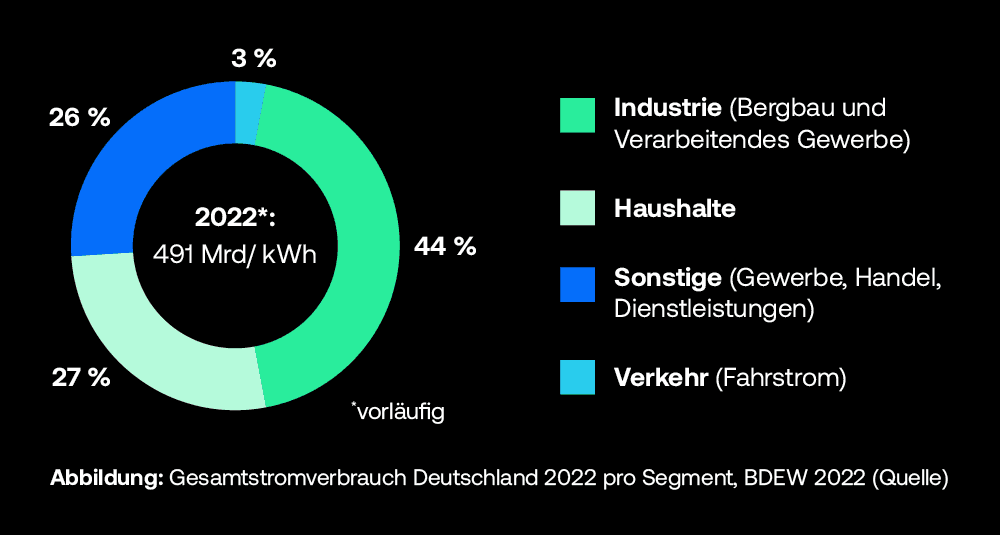
In this context, the share of energy-intensive companies with an annual electricity consumption of over 100,000 kilowatt-hours is particularly high, accounting for a total portion of 64 percent. Here, switching to green electricity can make a significant contribution to reducing emissions. Furthermore, the rising share of renewable energies affects electricity prices on the energy market. Even today, PV systems and wind turbines produce cheaper electricity than conventional power plants. This trend will intensify even more in the future.
Cheap, green industrial electricity only for
industrial companies?
Up to now, it has primarily been companies with energy-intensive production that could obtain cheap, green industrial electricity and benefit from unrestricted access to various energy procurement markets. These include companies from the manufacturing sector, metal processing, or the chemical industry. They often have their own energy trading departments, can employ experts, build the necessary IT infrastructure, and possess sufficient financial collateral to cover trading risks.
For SMEs, obtaining green industrial electricity represents a real challenge. They usually do not have the required resources to deal with the complex world and the non-stop changes in the electricity market. Moreover, investing in renewable energy plants (RE plants) and storage is not an easy endeavor for companies either, as it likewise requires knowledge and the availability of financial resources.
In addition, many renewable electricity products, such as Power Purchase Agreements (PPA), normally require high electricity consumption. This makes it difficult for companies with lower electricity needs to carry out forward-looking, strategic, and sustainable electricity procurement, raising the demand for transparent and efficient solutions for SMEs.
Changes in the Electricity Market and Regulatory Pressure
The Russian war of aggression against Ukraine and the resulting energy crisis have demonstrated how crucial forward-looking energy procurement as well as portfolio and risk management are. Quite a few companies got into brief difficulties due to the staggering energy prices on the power exchange and had to rely on state aid.
Although the situation has eased and prices have fallen again, volatility in the energy markets is still higher than before the crisis. At the same time, regulatory pressure on medium-sized enterprises is growing. For instance, the European Commission's Green Deal envisions EU member states becoming climate-neutral by 2050.
To achieve this goal, numerous regulations have recently been set in motion. While these were primarily aimed at the financial market and large corporations, SMEs are increasingly finding themselves confronted with them as well. For example, the EU sustainability directive (Corporate Sustainability Reporting Directive CSRD) obliges companies to report on sustainability in accordance with EU sustainability criteria.
Alongside the CSRD, there is a multitude of other frameworks that demand more sustainability from companies, some on a mandatory and others on a voluntary basis. Leading this effort is often the reduction of greenhouse gas emissions.
What does the CSRD Directive stand for?
The Corporate Sustainability Reporting Directive (CSRD) of the European Commission, which entered into force in 2023 as part of the Green Deal, requires companies to operate more sustainably and to reduce their greenhouse gas emissions.
The directive affects approximately 49,000 companies across Europe that are large companies in the accounting sense or capital market-oriented small and medium-sized enterprises (SMEs). This also transfers corresponding sustainability requirements to SMEs, increasing the pressure on companies to step up their activities for greater sustainability.
Green Electricity: A Lever for More Sustainability
In this context, the share of energy-intensive companies with an annual electricity consumption of over 100,000 kilowatt-hours is particularly high, accounting for a total portion of 64 percent. Here, switching to green electricity can make a significant contribution to reducing emissions. Furthermore, the rising share of renewable energies affects electricity prices on the energy market. Even today, PV systems and wind turbines produce cheaper electricity than conventional power plants. This trend will intensify even more in the future.
Cheap, green industrial electricity only for
industrial companies?
Up to now, it has primarily been companies with energy-intensive production that could obtain cheap, green industrial electricity and benefit from unrestricted access to various energy procurement markets. These include companies from the manufacturing sector, metal processing, or the chemical industry. They often have their own energy trading departments, can employ experts, build the necessary IT infrastructure, and possess sufficient financial collateral to cover trading risks.
For SMEs, obtaining green industrial electricity represents a real challenge. They usually do not have the required resources to deal with the complex world and the non-stop changes in the electricity market. Moreover, investing in renewable energy plants (RE plants) and storage is not an easy endeavor for companies either, as it likewise requires knowledge and the availability of financial resources.
In addition, many renewable electricity products, such as Power Purchase Agreements (PPA), normally require high electricity consumption. This makes it difficult for companies with lower electricity needs to carry out forward-looking, strategic, and sustainable electricity procurement, raising the demand for transparent and efficient solutions for SMEs.
Electricity purchasing