Updates
Industrial electricity price approved: What you need to know [May 2026 Update]

Written by:
Anne Fischer

Industrial Electricity Price at a Glance
The EU Commission has approved the industrial electricity price: €3.8 billion for Germany, limited until December 2028. [1]
Support is provided for 50% of annual electricity consumption; the electricity price will not fall below 5 cents per kWh. [1]
Eligible companies are from 91 energy-intensive (sub)sectors, and 50% of the aid must be reinvested. [2]
Unsure if your company is eligible for funding?
Check it here in just a few minutes:
Check eligibility now for free
Why the Industrial Electricity Price Matters Now
High energy costs have become an existential issue for many industrial companies in Germany. [3] This is precisely where the industrial electricity price comes in: The EU Commission has now approved the funding program with a budget of €3.8 billion for German industrial companies. [1]
The EU Commission established the exact industrial electricity price conditions on April 16, 2026. On May 6, 2026, the BMWE then published the guideline on granting the industrial electricity price for the billing years 2026 to 2028 in the Federal Gazette (Bundesanzeiger). [5]
This article breaks down the most important industrial electricity price conditions and components of the EU decision. It explains: What was decided? And who really benefits?
What is the Industrial Electricity Price?
The industrial electricity price is a state aid program for Germany. It is designed to temporarily relieve energy-intensive industrial companies of electricity costs.
The goal is to secure the competitiveness of industrial companies, thereby preserving sites and jobs. At the same time, it accelerates European decarbonization goals through a reinvestment obligation.
What Did the EU Commission Decide on the Industrial Electricity Price Support?
Under the Clean Industrial Deal State Aid Framework (CISAF), the EU Commission approved national aid schemes for energy-intensive industrial companies and defined eligibility criteria. [2]
The maximum funding amount in Germany is €3.8 billion. [1] The funding runs for up to three years, retroactive to January 1, 2026. It is limited until December 2028.
How High Is the Industrial Electricity Price Subsidy?
One of the central conditions of the industrial electricity price concerns the amount of support: The industrial electricity price subsidy instrument grants eligible companies aid for 50% of their annual electricity consumption.
The subsidy level for this quantity is generally 50% of the reference price. It ensures that the remaining electricity price does not drop below 5 cents per kilowatt hour. [1]
The reference price is the annual average of the Base Future contracts (i.e. the electricity forward prices traded on the exchange) of the previous year in the German-Luxembourg bidding zone. For 2026, the average of 2025 therefore applies. This reference price is uniform for all industrial companies.
An Example Calculation for the Subsidy Amount with Fulfilled Industrial Electricity Price Conditions
What the industrial electricity price subsidy actually means for a company is shown in the following example. With consumption of 10 GWh and a reference price of 8.7 cents per kWh, this results in a saving of approx. €185,000, as calculated in the following graphic:
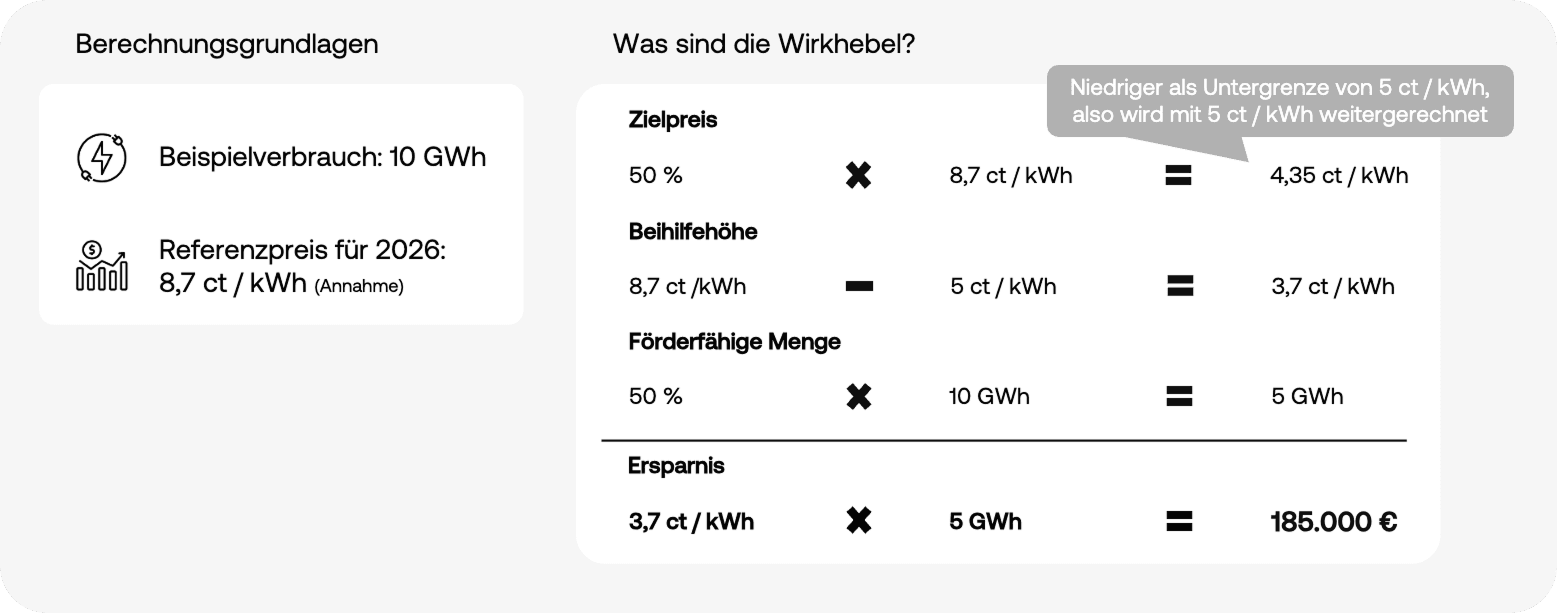
Graphic created by trawa [4]
Important to know here: The precise form of calculation has not yet been published. This represents a highly probable calculation baseline.
Who Gets the Funding? Industrial Electricity Price Conditions in Detail
Not every industrial company in Germany is directly eligible for funding. The industrial electricity price subsidy is targeted at companies from 91 specified (sub)sectors. [2] The EU Commission defined these based on the following criteria:
Energy intensity
International competitive pressure
This particularly affects industrial companies from energy-intensive sectors, such as
Steel and Aluminum
Chemicals
Glass and Ceramics
Paper and Pulp
Cement and Lime
Refineries and Non-Ferrous Metals
This sector list is based on the EU Guidelines on State Aid for Climate, Environmental Protection, and Energy.
Are you unsure whether your company meets the industrial electricity price conditions?
Check your eligibility for free with the trawa eligibility calculator.
What Does the Reinvestment Obligation for the Industrial Electricity Price Subsidy Mean?
A central condition of the industrial electricity price subsidy for industrial companies is the reinvestment obligation. Companies must reinvest 50% of the aid received in decarbonization measures. [2]
What might sound like a restriction at first is a strategic opportunity. Sponsored companies will lower their costs in the long term.
Which Measures Meet the Industrial Electricity Price Conditions?
The eligible measures are diverse. With careful planning, they lower costs in the long run:
Renewable energy generation
Integration of energy storage solutions
Demand-side flexibility to increase load flexibility (i.e. targeted adjustment of electricity consumption to market conditions)
Increasing energy efficiency
Electrolyzers
Electrification
Infrastructure modernizations of grid connections and internal distribution grids
Integration costs for electricity from renewable energy systems and construction cost subsidies
Costs from green power purchase agreements (PPAs) that finance new/modernized renewable energy installations [1]
We explain more about PPAs and dynamic tariffs as cost levers in energy procurement in the article “Commercial Electricity Price 2026: Mitigate the Risk of High Prices with Direct Power Purchase Agreements and Dynamic Tariffs”.
Which measures fit best depends on the individual consumption profile and sector of the respective company. Companies can already start implementing the committing measures at the beginning of the billing year.
This means: If a company applies for subsidies for the year 2026, the required measures can be initiated immediately.
trawa is specialized as a strategic partner for the planning and implementation of these measures. We support industrial companies all the way: from checking eligibility for industrial electricity price subsidies to green electricity supply, all the way to flexibilization via storage and demand response.
How to Reduce Your Energy Costs in the Long Term?
The industrial electricity price subsidy is limited to three years, provided conditions are met. It creates liquidity and time to establish structural solutions.
Yet, many challenges will persist beyond 2028. These include volatile energy markets, rising CO2 requirements, and international competitive pressure.
Companies can now use the funding strategically to modernize their energy procurement, such as through direct renewable supply, smart flexibilization, and data-based energy management. This way, after the subsidy expires, you are positioned more cost-effectively and resiliently than your competitors.
Read how a modern procurement mix combines predictability and market opportunities here: “From Fixed Price to Flexibility: This Is What the Modern Procurement Mix of 2026 Looks Like”
Check Industrial Electricity Price Conditions – How trawa Supports You
A structured review quickly provides clarity on whether your company is eligible for funding and which measures are concretely eligible.
trawa carries out this review free of charge and shows you which decarbonization measures are suitable and compliant with funding. This ranges from structured electricity procurement to battery storage and data-based energy management.
What this looks like in practice is demonstrated in our success story with LOXXESS. There you can see how LOXXESS implemented professional energy procurement through the intelligent portfolio of trawa, even without an internal purchasing team.
Approval of the Industrial Electricity Price: An Important Signal for Industrial Companies
The EU Commission's approval of the industrial electricity price is an important signal for European industry.
For companies in energy-intensive sectors, the program offers noticeable relief and, due to the reinvestment obligation, also prompts a structural modernization of energy procurement.
Industrial companies that check the industrial electricity price conditions and take action now secure an edge, regardless of how the energy market situation develops in the coming years.
Further details on the industrial electricity price and the industrial electricity price subsidy calculator can be found on the trawa Industrial Electricity Price page.
Frequently Asked Questions on the Industrial Electricity Price (FAQ)
How high is the industrial electricity price subsidy?
Support is provided for 50% of annual electricity consumption. The subsidy amounts to 50% of the reference price, whereby the remaining electricity price does not drop below 5 cents per kWh . [1]
Who is eligible for the industrial electricity price?
Eligible companies are those from 91 specified (sub)sectors – primarily energy-intensive industries such as steel, aluminum, chemical, glass, paper, and cement. Crucial criteria are energy intensity and international competitive pressure. [2]
When does the support apply and for how long?
The support applies retroactively from January 1, 2026 and is limited until December 2028 – meaning for up to three years. [1]
What does the reinvestment obligation mean?
50% of the aid received must be reinvested in decarbonization measures, such as renewable energies, storage, or energy efficiency. Work on these measures may begin from the start of the billing year. [2]
Next Steps on the Industrial Electricity Price: What Companies Should Do Now
Check eligibility: clarify whether your own sector is among the 91 eligible ones, e.g. with the subsidy calculator on the trawa Industrial Electricity Price page.
Plan reinvestment strategically: reinvest your subsidy specifically into battery storage, for example, and save beyond the industrial electricity price. Learn more in the article “Industrial Electricity Price 2026: How You Effectively Subsidize Your Battery Storage and Profit Twice”.
Think beyond 2028: Modernize energy procurement now. Practical approaches can be found in our article “Energy Procurement 2026: How SMEs Utilize New Market Opportunities for Low Electricity Prices”.
Do you still have questions?
[2] EU Commission Press Release, June 25, 2025. Clean Industrial Deal State Aid Framework (CISAF).
[3] Deutschlandfunk, April 16, 2026. EU Commission approves German industrial electricity price.
Updates